
The Best Behavioral Economics Books.
The research on how people actually make decisions — not how classical economic theory says they should
Behavioral economics is a distinct field from behavioral finance. Behavioral finance asks why markets misbehave — bubbles, panics, momentum. Behavioral economics asks a more basic question: why do individual people, across every domain of life, consistently make decisions that classical economic models say a rational actor never would? The five books on this list are the field's foundational texts, written by the researchers who built it — two of them Nobel laureates in Economic Sciences for exactly this work. Between them they cover cognitive bias and judgment under uncertainty, the systematic ways people deviate from rational choice, how small changes in how a decision is presented change what people choose, and what scarcity of money or time does to bandwidth and judgment. None of these are personal-finance how-to books — none will tell you which account to open — but they explain the mental machinery behind every financial decision you make, which is why we filed them separately from the market-behavior picks in our behavioral finance list.
Books written by the researchers who did the underlying work — not popularizations of someone else's studies — and grounded in published, peer-reviewed research rather than anecdote. We required each pick to cover a distinct piece of the field (judgment and bias, rational-choice deviation, choice architecture, scarcity and bandwidth) so the list works as a reading path rather than five variations on the same argument, and we excluded anything focused specifically on market behavior since that's already covered in our behavioral finance list.
The list, in order
- №1◈ Best starting point / the field's foundation
Thinking, Fast and Slow
by Daniel Kahneman · 2011
Daniel Kahneman won the 2002 Nobel Memorial Prize in Economic Sciences for the work this book distills — decades of research, much of it with the late Amos Tversky, on the two systems that drive human judgment: fast, intuitive System 1 and slow, deliberate System 2. It's the single most-cited foundation for every other book on this list, and the one to read first if you only read one.
- №2◈ Best for specific, repeatable decision traps
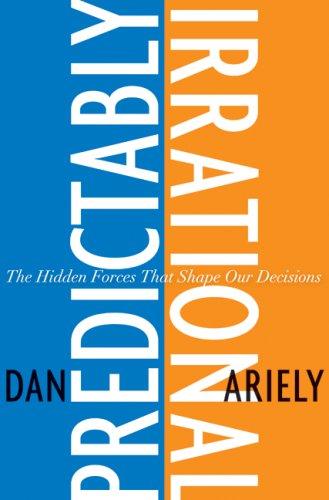
Predictably Irrational
by Dan Ariely · 2008
Dan Ariely, a Duke University professor of psychology and behavioral economics, walks through his own controlled experiments on anchoring, relativity, and the cost of "free" — showing that people don't deviate from rational choice randomly, they deviate in specific, repeatable, predictable ways. More accessible and narrative-driven than Kahneman's book, and a good second read once you have the System 1/System 2 framework in place.
- №3◈ Best for applying the research to your own choices
Nudge
by Richard H Thaler · 2008
Richard Thaler (2017 Nobel laureate in Economic Sciences) and Cass Sunstein introduce "choice architecture" — the idea that how options are presented (defaults, framing, ordering) changes what people choose, even when the options themselves are unchanged. It's the book that turned behavioral economics into applied policy, and the most directly useful of the five if you want to redesign your own financial defaults (automatic savings, auto-enrollment) rather than just understand your biases.
- №4◈ Best for understanding decisions made under financial pressure
Scarcity
by Sendhil Mullainathan · 2013
Sendhil Mullainathan (Harvard economist) and Eldar Shafir (Princeton psychologist) make the case that scarcity itself — of money, time, or anything else — captures mental bandwidth and produces worse decisions, independent of a person's underlying intelligence or discipline. It reframes financial-decision quality as partly a function of how much slack a person has, not just how much they know, and it's the one book here squarely about financial-specific scarcity rather than decision-making in general.
- №5◈ Best for applying the research specifically to investing
Your Money and Your Brain
by Jason Zweig · 2007
Jason Zweig, the Wall Street Journal's longtime "Intelligent Investor" columnist, translates neuroeconomics research — what's actually happening in the brain during financial decisions — into practical implications for investors specifically. It's the most finance-specific application of the four researchers' broader frameworks, and the natural last read once you understand the underlying cognitive science from the books above.



Get notified when our book picks change.
Set it once. We'll email you when a pick worth knowing about changes — no checking back.
Questions about this list
What's the difference between behavioral economics and behavioral finance?
Behavioral economics studies how people make decisions in general — the cognitive biases and mental shortcuts that apply to any choice, financial or not. Behavioral finance applies that research specifically to markets and investing: why bubbles form, why investors chase performance, why panic-selling happens. The books on this list are behavioral economics; see our behavioral finance list for the market-specific application.
Do I need an economics background to read these?
No. All five are written for a general audience — Thinking, Fast and Slow and Predictably Irrational in particular use everyday examples and simple experiments rather than technical economics. Nudge and Scarcity are similarly accessible. Your Money and Your Brain is the most finance-focused of the five but still doesn't assume prior investing knowledge.
Which book should I read first?
Thinking, Fast and Slow, if you want the foundational framework everything else builds on. If that feels like too much of a commitment, start with Predictably Irrational — it covers similar ground in a shorter, more narrative form — and come back to Kahneman's book once you want the deeper research.