
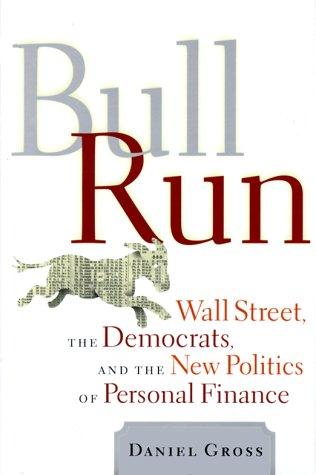
Bull Run

Curated by Brian Kim, CPA — every pick gets a plain-English summary and the key takeaways.
Brian Kim, CPA · 2.89M YouTube Subscribers →What this book actually teaches
- 01The dot-com boom followed a recognizable American pattern — railroads, autos, conglomerates — where real technology meets excess capital and self-reinforcing psychology.
- 02Specific policy choices enabled the bull: accommodative Fed, the 1997 capital-gains cut, 401(k)-driven equity defaults, and online-brokerage deregulation.
- 03Bubble vocabulary — "new economy," "eyeballs," "first-mover advantage" — is often the tell that the underlying economics aren't being valued.
- 04Day-trader and IPO culture, plus the celebrity-analyst phenomenon, were symptoms of late-stage speculation, not causes of it.
- 05The book was written before the crash, so it diagnoses better than it predicts — pair it with a post-bust history for the full arc.
What's in this book
Daniel Gross's argument is that the late-1990s bull market — the dot-com run that was still roaring when the book went to press in 2000 — was not a singular event but the latest entry in a long American pattern of speculative booms driven by genuine technological change, easy credit, and a self-reinforcing investor psychology that rewards the bold until it doesn't. Gross, a financial journalist who would later write for Slate and Newsweek, treats the bull market as a cultural and historical phenomenon as much as a financial one.
The core arguments come in three layers. First, the historical frame: Gross places the dot-com boom in a lineage with the railroad boom of the 1870s, the auto and radio boom of the 1920s, and the conglomerate and Nifty Fifty era of the 1960s. The pattern repeats — a real technological shift creates real winners, capital floods in faster than the technology can absorb it, and the late-stage speculation outruns the underlying economics. Second, the political and policy backdrop: the Greenspan Fed's accommodative posture, the capital-gains tax cut of 1997, the rise of 401(k) plans that channeled household savings into equities by default, and the deregulation that let Glass-Steagall erode and let online brokerages flourish. Gross is clear that the bull market wasn't just animal spirits — it had specific policy enablers.
Third, the cultural reporting. Gross is at his best as a journalist describing the texture of the moment: day-trader culture, the CNBC-ification of financial news, the cult of the IPO, the suddenly wealthy 28-year-old founders, the analysts who became celebrities, and the mutual-fund managers chasing performance into stocks they couldn't value. He documents the language of the era — "new economy," "eyeballs," "first-mover advantage" — with the eye of someone who senses the language itself is the tell.
Who this is for: investors and readers interested in market history who want a contemporaneous account of the dot-com bull, and anyone trying to recognize the pattern in a current boom.
Weaknesses
the book was published before the bust, which is both its charm and its limit. Gross is sharper on diagnosing the boom than on predicting the bust — he gestures at the risks without committing to a forecast, which leaves the reader without the closure a post-bust history can provide. The book is also a journalistic survey rather than an analytical framework; readers who want the underlying finance of bubbles will get more from Kindleberger's Manias, Panics, and Crashes or Galbraith's Short History of Financial Euphoria. And some of the cultural details that felt urgent in 2000 read as period pieces now, of more interest to historians than to active investors.
Verdict
a good companion piece to read alongside a post-bust history of the dot-com era. Not a standalone investing book, but a sharp slice of contemporaneous reporting.
Read next

For anyone who wants to invest seriously without becoming a day-trader — beginners willing to read carefully, and exp…
Buy on Amazon →
Early- and mid-career W-2 employees who want a single, executable wealth-building plan without becoming amateur portf…
Buy on Amazon →
For individual long-term investors who can hold concentrated positions for five to twenty years and want a framework…
Buy on Amazon →
For experienced investors who are comfortable with DCF mechanics and want a more disciplined, market-price-anchored f…
Buy on Amazon →About Daniel Gross
Read more from Daniel Gross and explore the full bibliography on ClearValue Books.
View Daniel Gross's page →Get an email if our take on Bull Run changes.
We re-review our picks. We'll email you if Bull Run's ranking or review changes — no checking back.
