
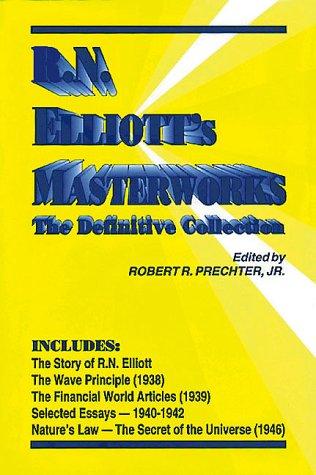
R.N. Elliott's masterworks

Curated by Brian Kim, CPA — every pick gets a plain-English summary and the key takeaways.
Brian Kim, CPA · 2.89M YouTube Subscribers →What this book actually teaches
- 01This is a primary-source compilation of Elliott's original writings, not a modern interpretation — readers can see the theory as Elliott developed it in the 1930s and 1940s.
- 02The core 5-3 wave structure (five impulse waves, three corrective waves) and its fractal, self-similar quality at all degrees of scale are established here in Elliott's own words.
- 03Elliott's Fibonacci connection — the ratios 0.618 and 1.618 governing proportional wave relationships — is central to the original theory, not a later addition.
- 04Wave labeling is subjective: practitioners routinely disagree about the current wave count, making prospective application harder than after-the-fact explanation.
- 05The theory's scope — from market pattern to universal natural law — goes well beyond what the empirical evidence supports; approach with appropriate skepticism.
What's in this book
R.N. Elliott's Masterworks is a compilation of Elliott's original writings — his 1938 monograph The Wave Principle, his 1939 Financial World articles, and his 1946 magnum opus Nature's Law: The Secret of the Universe — collected and edited by Robert Prechter, who has done more than anyone else to promote and codify Elliott Wave Theory in the modern era. The book is therefore not a Prechter interpretation but a primary source document: Elliott himself, in his own words, laying out the theory he developed in the 1930s while bedridden and recovering from a serious illness.
Elliott's core argument is that mass human behavior — specifically the collective buying and selling that produces financial market price movements — follows a fractal, repetitive pattern of five waves in the direction of the primary trend followed by three corrective waves against it, which he labeled the 8-wave cycle. Within each of those waves, the same 5-3 structure repeats at smaller degrees of scale, all the way down to intraday price action and all the way up to what Elliott called the Grand Supercycle spanning centuries of market history. The wave labels (1-2-3-4-5, A-B-C) and the rules that distinguish impulse waves from corrective waves — the centerpiece of what practitioners call the Elliott Wave Principle — are established in these original texts.
Elliott also argued that the pattern reflected deeper natural laws, specifically Fibonacci ratios (0.618, 1.618, 2.618), which he believed governed the proportional relationships between wave lengths. The Fibonacci connection was central to his thinking and has remained central to practitioners who use the method.
For technically oriented investors, historians of financial analysis, or practitioners of Elliott Wave who want to read the theory from its originator rather than from modern interpreters.
Weaknesses
Elliott Wave Theory is one of the most contested methods in technical analysis. Critics — including quantitative researchers — have consistently struggled to validate it in systematic backtests: the wave labeling rules are subjective enough that practitioners regularly disagree about what wave the market is currently in, which makes prospective application difficult and after-the-fact explanation easy. The Fibonacci ratios appear often enough in markets to be noticed but not reliably enough to be traded mechanically. The scope-creep in Elliott's claims — from market pattern to universal natural law governing human behavior across history — is a significant red flag for empirically minded readers. Reading the original texts also exposes how much of the modern Elliott Wave edifice has been built by Prechter and others rather than by Elliott himself.
Verdict
essential reading for anyone seriously studying Elliott Wave — you should read the originator before reading the interpreters. Approach it as a historical document and an intellectual artifact rather than as a trading manual.
Read next

For anyone who wants to invest seriously without becoming a day-trader — beginners willing to read carefully, and exp…
Buy on Amazon →
Early- and mid-career W-2 employees who want a single, executable wealth-building plan without becoming amateur portf…
Buy on Amazon →
For individual long-term investors who can hold concentrated positions for five to twenty years and want a framework…
Buy on Amazon →
For experienced investors who are comfortable with DCF mechanics and want a more disciplined, market-price-anchored f…
Buy on Amazon →About R N Elliott
Read more from R N Elliott and explore the full bibliography on ClearValue Books.
View R N Elliott's page →Get an email if our take on R.N. Elliott's masterworks changes.
We re-review our picks. We'll email you if R.N. Elliott's masterworks's ranking or review changes — no checking back.

Ready to read R.N. Elliott's masterworks?
Buy the edition we recommend on Amazon.
Buy on Amazon →