
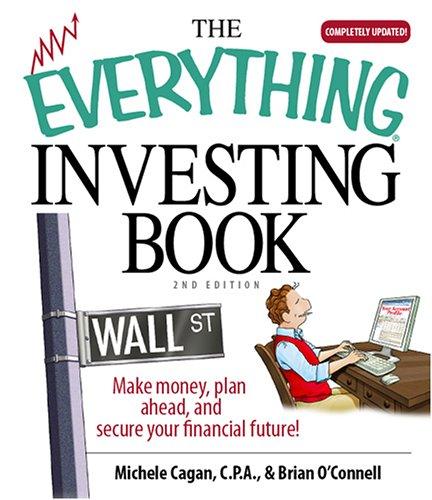
The everything investing book

Curated by Brian Kim, CPA — every pick gets a plain-English summary and the key takeaways.
Brian Kim, CPA · 2.89M YouTube Subscribers →What this book actually teaches
- 01The Everything series format prioritizes breadth over depth — the book functions as a survey map of the investing landscape (stocks, bonds, funds, REITs, alternatives, account types) rather than a deep treatment of any single topic.
- 02The account-type hierarchy — max employer-matched 401(k) first, then Roth IRA, then taxable accounts — is explained clearly and is the correct standard recommendation for most beginning investors.
- 03The third edition's behavioral section benefits from the 2008-2009 crisis context, giving concrete recent examples for selling at bottoms, chasing performance, and holding concentrated employer-stock positions.
- 04Specific contribution limits, tax rates, and financial thresholds are dated to 2009 and require verification against current IRS guidance before any account decision.
- 05The passive investing case — why low-cost index funds outperform most actively managed alternatives over long horizons — is not covered with the depth the evidence supports; readers who want that argument fully developed should supplement with dedicated passive-investing texts.
What's in this book
The Everything Investing Book (2009, third edition) by Michele Cagan is an introductory personal finance and investing guide in Adams Media's Everything series — a format designed to cover a topic comprehensively in accessible language without assuming prior expertise. Cagan, a CPA and financial writer, structures the book as a survey of the investing landscape: asset classes, account types, investment vehicles, basic portfolio construction, and the behavioral principles that determine whether individual investors actually capture the returns available to them. The third edition incorporates context from the 2008-2009 financial crisis, which had just occurred when the book was revised.
The coverage is broad by design. Cagan walks through stocks, bonds, mutual funds, exchange-traded funds, real estate investment trusts, and alternative investments including commodities. Each asset class receives a chapter that explains what it is, how returns are generated, what the risks are, and how it fits into a broader portfolio. The treatment is introductory for each topic — readers who want depth on any specific asset class will need to go further — but the survey format serves its purpose of giving complete beginners a map of the investing universe before they specialize.
The account types section is practically useful for beginners: the differences between a 401(k), IRA, Roth IRA, and taxable brokerage account are explained with attention to contribution limits, tax treatment, and withdrawal rules. Cagan is straightforward about the tax-advantaged account hierarchy — max employer-matched 401(k) contributions first, then Roth IRA if eligible, then taxable accounts — which is the standard recommendation and correct for most beginning investors.
The behavioral section covers the most common investing errors: selling during market downturns, chasing recent performance, holding concentrated positions in employer stock, and failing to rebalance. Cagan contextualizes these errors against the 2008 experience, making the discussion more concrete than a purely hypothetical treatment would be. The timing of the third edition gives the behavioral chapters an immediacy that earlier editions lacked.
The weaknesses are inherent in the Everything series format. Breadth competes with depth throughout — no topic receives the treatment it would get in a dedicated book. Specific numbers including contribution limits and tax rates are dated (the book was published in 2009) and should not be used as current guidance. The investment philosophy is appropriately conservative for a beginner audience but does not engage with the passive investing evidence deeply enough for readers who want to understand why low-cost index funds dominate the research on retail investor outcomes.
For investors who are starting from zero and want a structured overview of the entire investing landscape before committing to a specific approach, this book provides a competent introduction. Readers who have moved past the basics will not find new material.
Read next

For anyone who wants to invest seriously without becoming a day-trader — beginners willing to read carefully, and exp…
Buy on Amazon →
Early- and mid-career W-2 employees who want a single, executable wealth-building plan without becoming amateur portf…
Buy on Amazon →
For individual long-term investors who can hold concentrated positions for five to twenty years and want a framework…
Buy on Amazon →
For experienced investors who are comfortable with DCF mechanics and want a more disciplined, market-price-anchored f…
Buy on Amazon →About Michele Cagan
Read more from Michele Cagan and explore the full bibliography on ClearValue Books.
View Michele Cagan's page →Get an email if our take on The everything investing book changes.
We re-review our picks. We'll email you if The everything investing book's ranking or review changes — no checking back.

Ready to read The everything investing book?
Buy the edition we recommend on Amazon.
Buy on Amazon →