
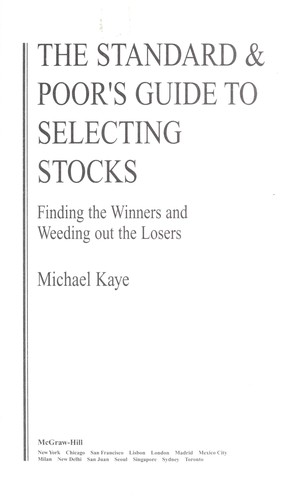
The Standard & Poor's guide to selecting stocks

Curated by Brian Kim, CPA — every pick gets a plain-English summary and the key takeaways.
Brian Kim, CPA · 2.89M YouTube Subscribers →What this book actually teaches
- 01The book translates S&P's STARS (Stock Appreciation Ranking System) methodology into individual investor terms, covering both the quantitative screens (earnings momentum, earnings quality, valuation) and the qualitative criteria (governance, competitive positioning) that drive STARS assignments.
- 02The earnings quality section distinguishes between reported earnings and real cash generation using accrual ratios, operating cash flow versus net income relationships, and revenue recognition consistency — tools that were particularly relevant in the post-Enron, post-SOX environment when the book was written.
- 03Interest rate sensitivity analysis is treated as a systematic screen rather than an ad hoc consideration — a useful framework for anticipating how sector and stock type performance shifts across different rate environments.
- 04The STARS ranking system itself is proprietary: readers can adopt the general philosophy and individual screening techniques, but the actual STARS rankings require S&P's paid subscription research, limiting the standalone utility of the methodology for retail investors.
- 05Published in 2005, the book predates the 2008 financial crisis, which revealed that even institutional earnings quality and governance screening methodologies had gaps; the crisis experience provides a useful stress test to apply when reading the screening criteria.
What's in this book
The Standard & Poor's Guide to Selecting Stocks (2005) by Michael Kaye, CFA, a portfolio analyst at Standard & Poor's Investment Advisory Services, translates the internal stock screening and selection methodology used by S&P's analyst team into a format accessible to individual investors. The book's organizing framework is S&P's STARS (Stock Appreciation Ranking System) rating system, a one-to-five-star ranking assigned to individual stocks based on the research team's twelve-month total return expectation. Kaye explains both what the STARS system measures and the screening techniques and fundamental criteria that drive STARS assignments.
The stock selection process the book describes operates in two stages. The first is quantitative screening: filtering the investable universe by criteria including earnings momentum, earnings quality, revenue growth consistency, balance sheet strength, and valuation relative to peers and historical norms. The second is qualitative analysis: assessing governance quality, competitive positioning, and management track record in ways that quantitative screens cannot capture. Kaye covers both stages with enough specificity that readers can apply similar screens independently using publicly available financial data.
The earnings quality section is one of the more substantive contributions. S&P's methodology distinguishes between reported earnings and earnings quality — the degree to which reported numbers reflect real cash generation rather than accounting choices. Kaye explains common earnings quality signals: the relationship between net income and operating cash flow, accrual ratios, and the consistency of revenue recognition policies. These tools were particularly relevant in the post-Enron, post-Sarbanes-Oxley environment in which the book was written, when accounting quality had become a mainstream investor concern rather than a specialist one.
The book also covers interest rate sensitivity analysis — how different sectors and stock types have historically responded to rising and falling interest rates — which Kaye presents as a systematic screen rather than an ad hoc consideration. This is practical for investors trying to anticipate how macroeconomic shifts will affect their existing holdings and potential additions.
The weaknesses reflect the book's institutional context. The S&P STARS system is proprietary, and the most valuable output of the methodology it describes — the actual STARS rankings — requires access to S&P's paid research. Readers can adopt the general philosophy and individual screening techniques without the subscription, but the competitive advantage of the STARS system (the proprietary database and analyst coverage behind it) is not replicable. The book was also published before the 2008 financial crisis, which revealed limitations in earnings quality and governance screening that even sophisticated institutional methodologies did not anticipate.
For individual investors who want a systematic, professionally grounded framework for stock selection — with particular emphasis on earnings quality, momentum, and governance — this book provides the S&P methodology in accessible form, though access to the STARS rankings themselves requires S&P's subscription research.
Read next

For anyone who wants to invest seriously without becoming a day-trader — beginners willing to read carefully, and exp…
Buy on Amazon →
Early- and mid-career W-2 employees who want a single, executable wealth-building plan without becoming amateur portf…
Buy on Amazon →
For individual long-term investors who can hold concentrated positions for five to twenty years and want a framework…
Buy on Amazon →
For experienced investors who are comfortable with DCF mechanics and want a more disciplined, market-price-anchored f…
Buy on Amazon →About Michael Kaye
Read more from Michael Kaye and explore the full bibliography on ClearValue Books.
View Michael Kaye's page →Get an email if our take on The Standard & Poor's guide to selecting stocks changes.
We re-review our picks. We'll email you if The Standard & Poor's guide to selecting stocks's ranking or review changes — no checking back.

Ready to read The Standard & Poor's guide to selecting stocks?
Buy the edition we recommend on Amazon.
Buy on Amazon →