
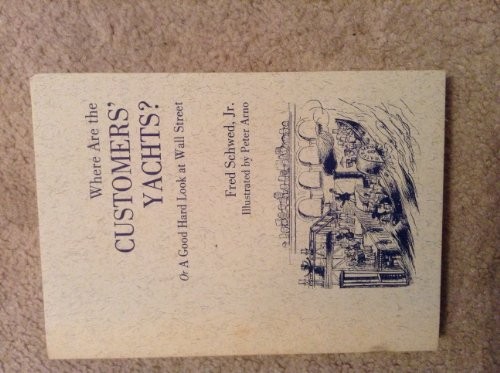
Where Are the Customer's Yachts? Or A Good Hard Look at Wall Street

Curated by Brian Kim, CPA — every pick gets a plain-English summary and the key takeaways.
Brian Kim, CPA · 2.89M YouTube Subscribers →What this book actually teaches
- 01The book's central argument — that Wall Street earns fees and commissions regardless of client outcomes, creating structural incentive to generate activity rather than wealth — was accurate in 1940 and remains structurally accurate today despite changes in instruments and market structure.
- 02Schwed's analysis of market forecasting is particularly durable: the industry's persistent overconfidence in its ability to predict market direction is, as he observes, not diminished by decades of contrary evidence.
- 03Leo Gough's 2007 introduction contextualizes Schwed's Depression-era Wall Street references against the modern financial services industry, translating the specific instruments while preserving the structural critique.
- 04The book is entirely a satirical literary critique — it contains no investment strategies, asset allocation frameworks, or portfolio construction advice, and readers expecting tactical guidance will be disappointed.
- 05The humor has dated unevenly; some passages read as sharply as they did in 1940 while others require historical context, but the underlying structural observations about advisor incentives remain as relevant as any contemporary critique.
What's in this book
Where Are the Customers' Yachts? was originally written by Fred Schwed Jr. and published in 1940. The edition introduced by Leo Gough (2007) brings Schwed's classic Wall Street satire back into print with a contemporary introduction that contextualizes its observations against the modern financial services industry. The book's title comes from a story Schwed recounts: a visitor to New York is shown the yachts of brokers and bankers, and asks where the customers' yachts are. The answer, of course, is that there aren't any. That punchline is the book's thesis: Wall Street is structured to enrich those who work in it, not the clients who fund it.
Schwed's book is not a how-to guide. It does not contain investment strategies, asset allocation frameworks, or portfolio construction advice. It is a satirical literary critique of Wall Street written by someone who had worked there and found the experience illuminating about the gap between Wall Street's self-presentation and the reality of how client money gets managed. The book covers the behavior of brokers and customers, the mechanics of speculation versus investment, the psychology of market participants, the role of analysts and forecasters, and the fundamental absurdity of Wall Street's claim to expertise in predicting market movements.
The central observations hold up across decades. Schwed's core point — that Wall Street earns fees and commissions regardless of whether clients profit, creating a structural incentive to trade and generate activity rather than to build client wealth — was accurate in 1940 and remains structurally accurate today. His analysis of market forecasting is particularly durable: the industry's persistent overconfidence in its ability to predict market direction is, as Schwed observes with considerable wit, not diminished by the evidence against it.
Gough's introduction does useful work in translating Schwed's Depression-era Wall Street references into their modern equivalents. The specific instruments and market structures have changed; the incentive structures have not. Gough identifies which chapters have aged well and which require the most contextual updating, which is a genuine service to contemporary readers.
The weaknesses are inherent to the source material. A satirical book from 1940 is not a practical guide to navigating modern markets, and readers who approach it expecting tactical investment advice will be disappointed. The humor has dated unevenly — some passages read as sharply as they did in 1940; others require more historical context to land. The book's value is entirely as a durable critique of Wall Street culture and incentives rather than as actionable investment guidance.
For investors who want a sharp, historically grounded perspective on why the financial services industry is structurally misaligned with client interests — delivered with genuine wit rather than regulatory dry language — this book remains one of the most useful 150 pages on the subject.
Read next

For anyone who wants to invest seriously without becoming a day-trader — beginners willing to read carefully, and exp…
Buy on Amazon →
Early- and mid-career W-2 employees who want a single, executable wealth-building plan without becoming amateur portf…
Buy on Amazon →
For individual long-term investors who can hold concentrated positions for five to twenty years and want a framework…
Buy on Amazon →
For experienced investors who are comfortable with DCF mechanics and want a more disciplined, market-price-anchored f…
Buy on Amazon →About Fred Schwed Jr
Read more from Fred Schwed Jr and explore the full bibliography on ClearValue Books.
View Fred Schwed Jr's page →Get an email if our take on Where Are the Customer's Yachts? Or A Good Hard Look at Wall Street changes.
We re-review our picks. We'll email you if Where Are the Customer's Yachts? Or A Good Hard Look at Wall Street's ranking or review changes — no checking back.

Ready to read Where Are the Customer's Yachts? Or A Good Hard Look at Wall Street?
Buy the edition we recommend on Amazon.
Buy on Amazon →