
The Best Technical Analysis Books.
From chart patterns to market indicators — the essential reading list
Technical analysis has a reputation problem. In the hands of retail traders who half-read a single chart-pattern book, it becomes a collection of shapes on a screen with no coherent theory behind them. In the hands of practitioners who have spent years studying volume behavior, intermarket relationships, and the mathematics of momentum, it becomes a systematic edge. The books on this list belong to the second tradition. They were written by analysts who spent careers at institutional desks, managed real money under technical frameworks, and — crucially — documented what worked and what didn't. Whether you're learning support and resistance for the first time or deepening an existing framework with divergence analysis and breadth indicators, this list covers the discipline from its most accessible entry points through to its most rigorous academic treatment. Read them in order and you'll have a stronger technical foundation than most traders who have been in the market for a decade.
Every book on this list had to demonstrate a testable, repeatable methodology — not just visual pattern recognition. Author credentials were weighted toward practitioners with verifiable track records. Books that rely on hindsight-biased chart examples without addressing failure rates were excluded.
The list, in order
- №1◈ Reference Encyclopedia
Technical analysis from A to Z
by Steven B Achelis · 2001
Steven Achelis built the industry-standard reference that every serious technician keeps within reach. Each indicator is described with its formula, interpretation, trading signals, and historical context — making it easy to understand not just what an indicator shows but why it was designed that way. The alphabetical structure means you can use it as a daily reference even after reading it cover to cover.
- №2◈ Advanced Methodology
Technical analysis for the trading professional
by Constance M Brown · 1999
Constance Brown's book is the rare technical analysis text aimed explicitly at professionals rather than beginners. Her work on oscillator behavior — particularly the observation that RSI behaves differently in bull and bear markets — corrects one of the most persistent misreadings in the field. The chapter on Fibonacci price projections combined with Gann time cycles is among the most sophisticated treatment of confluence analysis in print.
- №3◈ Statistical Backtesting
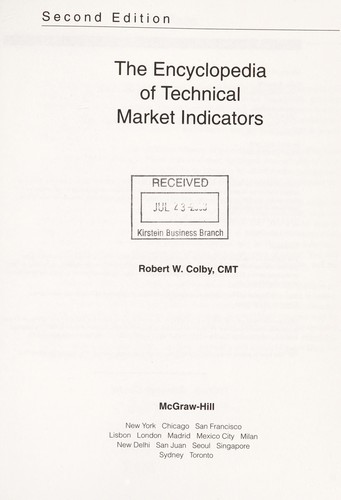
The encyclopedia of technical market indicators
by Robert W Colby · 2003
Robert Colby's encyclopedia is the most statistically rigorous book in this genre. Every major indicator is back-tested against decades of market data with explicit win rates, average profit, and comparative rankings. For traders who want evidence rather than anecdote, this book is indispensable — it will also cure you of any indicator you've been using on faith alone.
- №4◈ Candlestick & Japanese Methods
Beyond candlesticks
by Steve Nison · 1994
Steve Nison's follow-up to his landmark candlestick introduction goes deeper into the Japanese charting techniques that most Western analysts still ignore. The sections on three-line break charts and Renko charts offer genuine alternatives to traditional bar charting that strip out time and focus purely on price movement — a perspective shift that reorganizes how you see momentum and reversal.
- №5◈ Momentum Theory
Momentum, direction, and divergence
by William Blau · 1995
William Blau's treatment of momentum is mathematically grounded in a way that most popular momentum books are not. He formalizes the concept of true strength index (TSI) and shows how double-smoothed momentum indicators reduce noise while preserving signal. For traders who rely on MACD or RSI as black boxes, this book opens the hood and explains exactly what those tools are measuring and where they fail.




Get notified when our book picks change.
Set it once. We'll email you when a pick worth knowing about changes — no checking back.
Questions about this list
Is technical analysis actually predictive, or is it self-fulfilling?
Both effects are real and compound each other. Support and resistance levels work partly because enough participants watch the same levels — but they also encode genuine supply/demand imbalances. The statistical back-testing in 'The Encyclopedia of Technical Market Indicators' shows which tools have measurable predictive value beyond what self-fulfilling prophecy alone would produce.
Should I learn candlestick patterns or bar charts first?
Learn bar charts first — they make the OHLC relationship explicit and build the intuition that candlestick patterns compress. Once you understand what a bar is measuring, candlestick interpretation becomes faster and more reliable. 'Beyond Candlesticks' assumes bar-chart literacy and builds from there.
How many indicators do I actually need to trade effectively?
Most professional technicians rely on two to four indicators, chosen for non-correlation — typically one trend indicator, one momentum oscillator, and one volume-based tool. 'Technical Analysis from A to Z' will help you understand your choices; 'The Encyclopedia of Technical Market Indicators' will help you pick the ones with the best historical performance.