
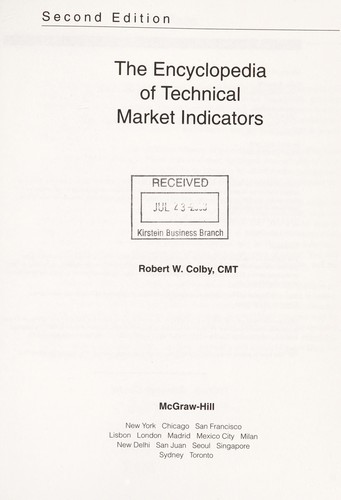
The encyclopedia of technical market indicators

Curated by Brian Kim, CPA — every pick gets a plain-English summary and the key takeaways.
Brian Kim, CPA · 2.89M YouTube Subscribers →What this book actually teaches
- 01Most technical indicators fail to beat buy-and-hold after transaction costs — Colby's backtests are sobering for indicator enthusiasts.
- 02Simpler trend-following systems (basic moving-average crossovers, some breadth measures) tend to hold up better than complex oscillators.
- 03Comparative backtesting with a consistent methodology is the right way to evaluate indicators; cherry-picked anecdotes are not.
- 04The book is a desk reference for systematic traders, not a narrative introduction to technical analysis.
- 05Backtests from 2003 predate algorithmic dominance and regime changes — results need to be revalidated on current data before use.
What's in this book
Robert Colby's book is exactly what its title says — a reference work, not a narrative. The 2003 second edition runs to roughly 800 pages and catalogs more than 100 technical indicators, oscillators, and market-breadth measures, with each entry describing the indicator's construction, its historical use, and — critically — Colby's backtested results against decades of market data. The book's distinctive contribution is that it doesn't just describe indicators; it ranks them by measured performance.
The organization is encyclopedic. Each indicator gets a standardized treatment: definition, calculation formula, historical context, signal-generation rules, and Colby's empirical backtest results (typically against the Dow Jones Industrial Average across multiple decades). The indicators span the full technical universe: moving averages and crossover systems, momentum oscillators (RSI, stochastics, MACD), volatility measures (Bollinger Bands, ATR), volume-based indicators (on-balance volume, accumulation/distribution), market-breadth indicators (advance/decline lines, McClellan oscillator), sentiment measures, and lesser-known constructions from across the technical-analysis literature.
The analytical centerpiece is the comparative backtesting. Colby applies a consistent methodology to all indicators and ranks them by risk-adjusted performance. The findings are sobering for technical-analysis enthusiasts: many widely cited indicators fail to beat buy-and-hold after transaction costs, and the ones that do tend to be simpler than the literature gives them credit for. Some breadth indicators and basic trend-following moving-average systems hold up; many oscillators do not.
Who this is for: serious technical traders, quantitative researchers, and anyone building a systematic strategy who needs a reference for what indicators actually are and how they have historically performed. Not for casual readers — this is a desk reference, not a sit-down read.
Weaknesses are real. The 2003 backtests predate the post-2008 market regime, the rise of high-frequency trading, the decimalization aftermath, and the algorithmic dominance that has thinned many edges Colby's results identified. Some indicators that worked when his data ended have since been arbitraged away or have failed in regime changes. The methodology — backtesting on the DJIA — is also a single index with survivorship and composition effects that may not generalize cleanly. Critics note that the book provides no theoretical framework for WHY some indicators work; it is empirical-only, which leaves readers without guidance for adapting the indicators to new market regimes. And the encyclopedic structure means there is no narrative arc — readers must do the synthesis work themselves.
Verdict
indispensable as a reference if you are doing systematic technical work; not the book to read if you want to understand technical analysis as a discipline. Pair it with a methodological book (Pring or Murphy) for the framework, and use Colby for the empirical lookup.
Read next

For anyone who wants to invest seriously without becoming a day-trader — beginners willing to read carefully, and exp…
Buy on Amazon →
Early- and mid-career W-2 employees who want a single, executable wealth-building plan without becoming amateur portf…
Buy on Amazon →
For individual long-term investors who can hold concentrated positions for five to twenty years and want a framework…
Buy on Amazon →
For experienced investors who are comfortable with DCF mechanics and want a more disciplined, market-price-anchored f…
Buy on Amazon →About Robert W Colby
Read more from Robert W Colby and explore the full bibliography on ClearValue Books.
View Robert W Colby's page →Get an email if our take on The encyclopedia of technical market indicators changes.
We re-review our picks. We'll email you if The encyclopedia of technical market indicators's ranking or review changes — no checking back.
Across the site
Featured in lists
- The Best Technical Analysis Books (#3 pick)

Ready to read The encyclopedia of technical market indicators?
Buy the edition we recommend on Amazon.
Buy on Amazon →