
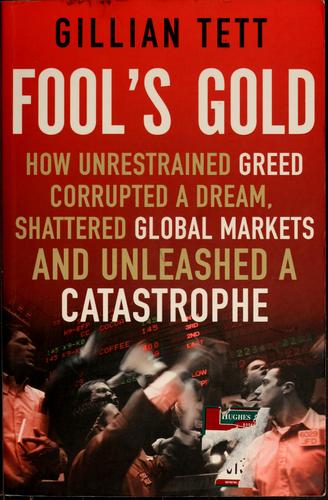
Fool's Gold

Curated by Brian Kim, CPA — every pick gets a plain-English summary and the key takeaways.
Brian Kim, CPA · 2.89M YouTube Subscribers →What this book actually teaches
- 01Credit derivatives began as a genuine risk-management innovation at J.P. Morgan in the 1990s — the BISTRO structure they developed was designed with risk controls the banks that copied it in the 2000s deliberately omitted.
- 02Tett's anthropological lens identifies tribal insularity as a structural failure mode: specialized knowledge creates subcultures within institutions that are effectively invisible to senior management and regulators, which is how the derivatives risk accumulated without adequate oversight.
- 03AAA ratings on CDO tranches were the critical error that allowed pension funds and money market funds to hold instruments far riskier than their mandates permitted — and those ratings were built on historical models that excluded the possibility of a national housing price decline.
- 04The book is a focused origin story of credit derivatives, not a comprehensive crisis narrative — it should be read alongside broader accounts like The Big Short or Too Big to Fail for the full institutional and political picture.
- 05The central lesson extends beyond finance: when specialized knowledge produces institutional blind spots, and when the people who created an instrument are no longer the ones applying it, the original risk controls tend to disappear.
What's in this book
Fool's Gold: How the Bold Dream of a Small Tribe at J.P. Morgan Was Corrupted by Wall Street Greed and Unleashed a Catastrophe (2009) by Gillian Tett is one of the most important books written about the 2008 financial crisis — not because it covers the crisis comprehensively, but because it traces the specific intellectual and institutional lineage of the credit derivatives that brought the global financial system to its knees. Tett, a Financial Times journalist with a social anthropology PhD, writes about finance through the lens of institutional culture, and that perspective produces a book that is more illuminating than most crisis narratives.
The book's thesis is that the credit derivatives market — specifically collateralized debt obligations (CDOs) and credit default swaps (CDSs) — began as a genuinely useful innovation developed by a team at J.P. Morgan in the early 1990s and was subsequently distorted, scaled beyond its original risk-management purpose, and applied to asset classes (subprime mortgage pools) the original designers explicitly warned against. The J.P. Morgan team that created the BISTRO (Broad Index Secured Trust Offering) structure in 1997 built in risk controls and held their own exposure; the banks that replicated their innovation in the 2000s did neither.
Tett's anthropological approach produces several analytical insights that conventional financial journalism misses. She documents the tribal insularity of the derivatives team — the way that specialized knowledge creates a subculture within a large institution that is effectively invisible to management, regulators, and outsiders. The J.P. Morgan derivatives team could not fully explain their own products to the bank's senior leadership, not because the leaders were unsophisticated, but because the complexity of the instruments exceeded what could be communicated upward in a normal institutional hierarchy. This dynamic — specialized knowledge producing institutional blind spots — is the book's most broadly applicable lesson.
The narrative tracks the period from the BISTRO innovation through the CDO-squared and synthetic CDO proliferation of 2004-2007, with attention to the specific regulatory and accounting rules (Basel II capital treatment of off-balance-sheet structures, the AAA rating shortcut) that made the leverage accumulation invisible to risk managers and regulators simultaneously. Tett is particularly good on how the ratings agency models — built on historical data that didn't include a national housing price decline — produced AAA ratings for structures that were anything but.
Weaknesses
Fool's Gold is not a comprehensive crisis narrative. It does not cover the failure mechanisms at Lehman Brothers, AIG's specific CDS exposure, or the government intervention in as much depth as books like Andrew Ross Sorkin's Too Big to Fail or Michael Lewis's The Big Short. Readers who want the full political and institutional story of the crisis response will find Tett's focus on the J.P. Morgan lineage both illuminating and incomplete. The book also requires some familiarity with basic derivatives concepts — while Tett explains the instruments more clearly than most, the material is not accessible to readers who have never encountered the terms.
Verdict
the essential book for understanding where credit derivatives came from and how a legitimate risk-management innovation became a systemic risk amplifier. Best read alongside a broader crisis narrative for full context.
Read next

For anyone who wants to invest seriously without becoming a day-trader — beginners willing to read carefully, and exp…
Buy on Amazon →
Early- and mid-career W-2 employees who want a single, executable wealth-building plan without becoming amateur portf…
Buy on Amazon →
For individual long-term investors who can hold concentrated positions for five to twenty years and want a framework…
Buy on Amazon →
For experienced investors who are comfortable with DCF mechanics and want a more disciplined, market-price-anchored f…
Buy on Amazon →How Fool's Gold stacks up
About Gillian Tett
Read more from Gillian Tett and explore the full bibliography on ClearValue Books.
View Gillian Tett's page →Get an email if our take on Fool's Gold changes.
We re-review our picks. We'll email you if Fool's Gold's ranking or review changes — no checking back.
