
Business Model Canvas

Curated by Brian Kim, CPA — every pick gets a plain-English summary and the key takeaways.
Brian Kim, CPA · 2.89M YouTube Subscribers →What this book actually teaches
- 01The Business Model Canvas maps any business across nine building blocks — customer segments, value propositions, channels, customer relationships, revenue streams, key resources, key activities, key partnerships, and cost structure — on a single visual page that makes the internal logic of the model legible.
- 02The canvas's right side (segments, propositions, channels, relationships, revenues) represents external value creation logic; the left side (resources, activities, partnerships, costs) represents operational infrastructure — and the insight is in how the two sides connect.
- 03Business model patterns — long tail, multi-sided platforms, freemium, open models, unbundled corporation — give strategists a vocabulary for recognizing when a situation resembles a known structure versus when it requires genuinely novel design.
- 04The canvas is a mapping tool, not a strategy generator: filling in nine boxes with plausible content is easy, but the framework doesn't distinguish strong from weak choices within each block or test whether the model will actually work in the market.
- 05Business model innovation is treated as a design discipline — iterative, visual, prototype-driven — rather than a purely analytical exercise, which is the book's most durable contribution beyond the canvas itself.
What's in this book
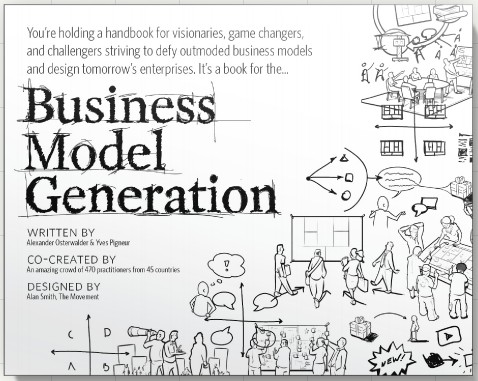
Business Model Generation by Alexander Osterwalder and Yves Pigneur, published by Wiley in 2010, introduced the Business Model Canvas — a single-page visual framework that maps any business model across nine building blocks: customer segments, value propositions, channels, customer relationships, revenue streams, key resources, key activities, key partnerships, and cost structure. The canvas became one of the most widely adopted strategy tools in the world, used in business schools, accelerators, and corporate innovation teams globally. The book's core argument is that business model design deserves the same structured, visual, iterative thinking that product design gets — and that the primary reason companies fail to innovate their business models is the absence of a shared language and visual tool for doing so.
The nine-block canvas is the book's central intellectual contribution, and Osterwalder spends the first half building it in detail. Customer segments define who the business creates value for; value propositions define what distinct value it delivers to each segment; channels describe how the value is delivered; customer relationships address the nature of the connection (self-service vs. dedicated support vs. community); revenue streams explain how the business captures value from each segment. The right side of the canvas — segments, propositions, channels, relationships, revenues — represents the business's external logic. The left side — resources, activities, partnerships, costs — represents its operational infrastructure. The canvas is designed to make the internal logic of how the right side and left side connect visible on a single page.
The second half of the book extends the canvas into a broader strategy toolkit. Osterwalder introduces business model patterns — recurring configurations that appear across industries, including the long tail model, multi-sided platforms, freemium, open business models, and the unbundled corporation. The pattern library is useful because it gives strategists a vocabulary for recognizing when their situation resembles a well-understood structure and when it genuinely requires novel design. A dedicated section on business model design covers the ideation, prototyping, and testing process — treating business model innovation as a design discipline rather than a purely analytical one. The book also addresses how to evaluate and evolve an existing business model, including SWOT analysis adapted for business model assessment.
Who this is for: entrepreneurs designing new ventures, corporate strategy and innovation teams working on business model transformation, MBA students learning strategic analysis frameworks, and consultants who need a shared visual language for working with clients on strategy.
Weaknesses
the canvas is a mapping tool, not a strategy tool — it describes the current or desired state of a business model but does not in itself generate strategic insight about what the model should be or how to improve it. Critics note that the canvas can give a false sense of comprehensiveness: filling in nine boxes with plausible-sounding content is easy, and the framework doesn't distinguish between strong and weak choices within each block. The book's case studies are curated success stories, which understates how many business models that pass the internal-logic test fail in the market for reasons the canvas doesn't surface. For complex multi-business-unit enterprises, the single-canvas format can also oversimplify by forcing a single business model view onto organizations that genuinely operate multiple distinct models simultaneously.
Verdict
the Business Model Canvas is the most useful single-page strategy framework available for mapping and communicating business model logic; the book that introduced it is worth reading to understand the framework's full architecture and the design discipline it was meant to enable.
Read next

Engineers, scientists, and researchers considering or early in the process of commercializing a technical innovation…
Buy on Amazon →
Small business owners — particularly those with five or more years of meaningful profitability — who want a CPA-ancho…
Buy on Amazon →
Tax professionals, policy analysts, and informed citizens who want to understand the structural case for replacing th…
Buy on Amazon →
Small-business owners, entrepreneurs, and anyone who files a complicated return and wants to understand why the syste…
Buy on Amazon →About Alexander Osterwalder
Read more from Alexander Osterwalder and explore the full bibliography on ClearValue Books.
View Alexander Osterwalder's page →Get an email if our take on Business Model Canvas changes.
We re-review our picks. We'll email you if Business Model Canvas's ranking or review changes — no checking back.

Ready to read Business Model Canvas?
Buy the edition we recommend on Amazon.
Buy on Amazon →