
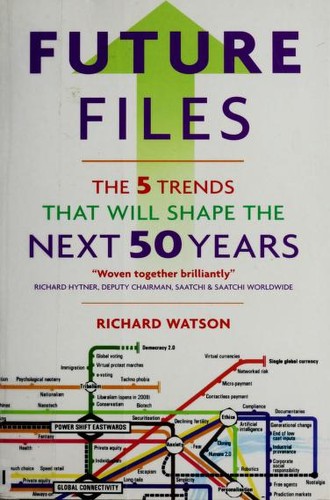
Future files

Curated by Brian Kim, CPA — every pick gets a plain-English summary and the key takeaways.
Brian Kim, CPA · 2.89M YouTube Subscribers →What this book actually teaches
- 01The book's value is explicitly not in predictive accuracy but in modeling the discipline of thinking through second- and third-order consequences of trends already in motion — Watson frames it as a thinking tool, not a forecast.
- 02The money and retail sections age best: the digital payment acceleration, cash erosion, microtransaction growth, and barbell bifurcation of retail markets (extreme value vs. extreme experience, middle squeezed out) are well-supported by post-2008 data.
- 03The 10-domain, 50-trend grid structure gives the book unusual density for the genre — one-page treatments per trend make it a reference to work through by domain rather than a cover-to-cover narrative argument.
- 04Watson's scenario-planning section bridges futures thinking to organizational decision-making, distinguishing Future Files from pure prediction books that leave readers without a practical planning bridge.
- 05The 2008 vintage makes the AI and technology predictions particularly dated — useful as a retrospective exercise on which extrapolations held versus which were disrupted by discontinuous events, but not a reliable forward-looking planning resource without supplementation.
What's in this book
Future Files by Richard Watson, published in 2008, is a structured futures-thinking exercise that maps 50 trends Watson believes will shape the next 50 years across ten domains: food, retail, money, health, the home, work, transportation, technology, education, and politics. Watson, a futurist and founder of the trend-tracking publication What's Next, does not write as a prophet — the book is explicit that its value is not in the accuracy of specific predictions but in the discipline of thinking through second- and third-order consequences of trends that are already visible and accelerating.
The book's organizational logic is a grid: 10 domains, 5 trends each, one-page treatment per trend. That structure gives the book unusual density for a popular-business futurism title — Watson does not build chapters around narrative arcs but around concise, specific trend claims. The money and retail sections are the most directly relevant to business readers. On money, Watson's 2008-era predictions about digital payment acceleration, the erosion of cash, the growth of microtransactions, and the increasing financialization of everyday objects hold up well against what has actually occurred in the intervening years. His prediction of fragmented personal financial identity — multiple currency relationships, loyalty programs functioning as shadow currencies, the blurring of saving and spending — presaged what has become the embedded finance trend.
The retail section argues for the bifurcation of markets into extreme value and extreme experience, with the middle squeezed out — a dynamic that is well-documented in post-2008 retail data. Watson's framework for thinking about this bifurcation (he calls it the barbell) has become standard in retail strategy consulting, though he does not use that term. The distribution and logistics predictions are less specific but directionally correct about the growing consumer expectation for speed and transparency in fulfillment.
The work and technology sections are less precise. Watson's predictions about remote work are directionally accurate but miss the COVID acceleration by a decade and a massive forcing function. His technology predictions, written in 2008, have aged variably — the social media predictions are broadly accurate; the AI predictions underestimate the speed and nature of what has actually emerged.
Watson's framing device throughout is what he calls a trends map, positioning each trend on axes of likelihood and impact. The device is useful for structured thinking even when the specific trend claims are debatable. The book also includes a section on how to use scenario planning in organizational decision-making — a practical bridge from futures thinking to strategic planning that distinguishes it from pure prediction books.
This is for business leaders, strategists, and planners who want a structured framework for thinking about long-range trends rather than a single narrative argument — particularly readers who find most futurism books too thesis-heavy and want a reference they can work through systematically by domain.
The weaknesses are the format and the vintage. The one-page-per-trend structure optimizes for breadth over depth — readers who want a sustained argument about any single trend will find the treatment insufficient and will need more specialized sources. The 2008 publication date makes this a useful retrospective exercise (which predictions held, which missed, and why) rather than a forward-looking planning tool without supplementation. Watson's tone is confident without always acknowledging the limits of trend extrapolation — the risks of over-indexing on visible trends versus discontinuous disruption are present in the framing but not systematically addressed.
For readers interested in how a professional futurist structured domain-by-domain trend analysis in 2008 — and for those who want a template for applying similar structured thinking to their own industry — Future Files remains a useful model of how to organize foresight work even where the specific content has been overtaken by events.
Read next
For entrepreneurs designing new ventures, corporate innovation teams working on business model transformation, MBA st…
Buy on Amazon →
Engineers, scientists, and researchers considering or early in the process of commercializing a technical innovation…
Buy on Amazon →
Small business owners — particularly those with five or more years of meaningful profitability — who want a CPA-ancho…
Buy on Amazon →
Tax professionals, policy analysts, and informed citizens who want to understand the structural case for replacing th…
Buy on Amazon →About Richard Watson
Read more from Richard Watson and explore the full bibliography on ClearValue Books.
View Richard Watson's page →Get an email if our take on Future files changes.
We re-review our picks. We'll email you if Future files's ranking or review changes — no checking back.
