
The Best Retirement Books for FIRE Aspirants.
Financial Independence, Retire Early — the reading list
The FIRE movement asks a simple but radical question: what if retirement didn't have to wait until 65? Financial Independence, Retire Early is less a specific number and more a set of principles — aggressive saving rates, index-fund investing, and a clear-eyed look at what 'enough' actually means for your life. The math is deceptively straightforward once you understand it: lower your expenses, invest the gap, and at a 4% withdrawal rate you can walk away from a traditional career far sooner than conventional wisdom suggests. But the intellectual and psychological groundwork is harder. The books in this list have shaped the FIRE movement from its earliest days, from Vicki Robin's foundational work on the relationship between money and life energy to JL Collins's unflinching case for index funds to Scott Trench's practical blueprint for building wealth in your 20s and 30s. Whether you're pursuing full FIRE, Coast FIRE, or simply want more optionality in your career, these books will give you the conceptual foundation and tactical tools to get there.
We prioritized books that directly address early retirement math, safe withdrawal rates, and the philosophical underpinning of financial independence. Titles had to engage seriously with the 'why' of FIRE — not just the wealth accumulation mechanics but the question of what you're retiring to. We excluded general investing books that don't address early retirement specifically, and we gave extra weight to books that have demonstrably shaped the community.
The list, in order
- №1◈ The FIRE Foundation
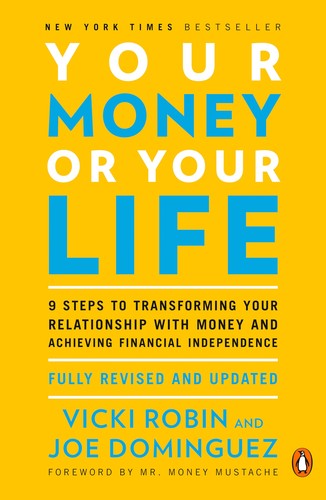
Your Money or Your Life: 9 Steps to Transforming Your Relationship with Money and Achieving Financial Independence
by Vicki Robin · 1992
◈CanonThe book that started it all. Vicki Robin's framework for calculating your 'real hourly wage' and tracking spending against life energy is the philosophical bedrock of the entire FIRE movement. Even readers who disagree with some of its prescriptions find that it permanently reframes the relationship between money, time, and meaning. Read this before anything else.
- №2◈ Best Investment Framework
The Simple Path to Wealth
by Jl Collins · 2016
◈Canon★Brian's PickJL Collins distilled years of blog posts into the clearest, most direct argument for total stock market index fund investing available anywhere. His F-you Money framework and 4% rule explanation are required reading for anyone pursuing financial independence. The writing is warm and direct — it reads like advice from a trusted friend who happens to know a lot about markets.
- №3◈ Best for Early-Career FIRE
Set for life
by Scott Trench
Scott Trench's book is the most actionable early-FIRE blueprint for people starting from zero, specifically targeting the 20s and 30s demographic. He walks through house hacking, income optimization, and the precise sequence of wealth-building moves that maximize early retirement probability. If 'Your Money or Your Life' is the philosophy, this is the tactical manual.
- №4◈ Best for Philosophical Grounding
How Much Is Enough?: Money and the Good Life
by Robert Skidelsky · 2012
The FIRE movement's most underread companion. Robert and Edward Skidelsky's philosophical inquiry into what constitutes a 'good life' directly challenges the accumulation mindset and asks when enough is actually enough. For FIRE aspirants who want to think rigorously about what they're optimizing for — not just the number — this book is essential.
- №5◈ Best Data-Driven Case for Frugality
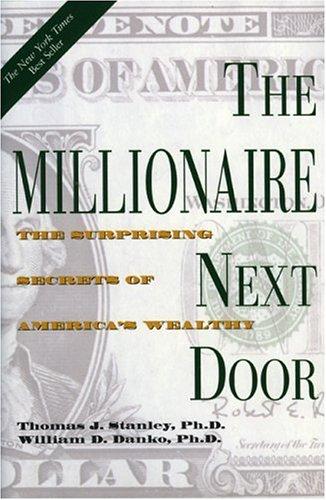
The Millionaire Next Door
by Thomas Stanley · 1996
◈Canon★Brian's PickStanley and Danko's landmark study of actual millionaire behavior in America remains one of the most powerful empirical arguments for frugality and below-means living. FIRE's core insight — that wealth is what you don't spend — is validated page after page with real data. It's the antidote to lifestyle inflation and the best evidence base for why the FIRE approach works.


Get notified when our book picks change.
Set it once. We'll email you when a pick worth knowing about changes — no checking back.
Questions about this list
What savings rate do I need to retire early?
The math varies by starting point, but the general rule: a 50% savings rate gets you to financial independence in roughly 17 years from a zero base; 65% gets you there in about 10. The key variable is your expense level, since that determines both how fast you accumulate and what your portfolio needs to sustain. JL Collins's 'The Simple Path to Wealth' and the Mr. Money Mustache blog walk through the math in detail.
Is the 4% rule safe for a 40-year retirement?
The original Trinity Study covered 30-year periods. Extended research (the Pfau studies, ERN's sequence-of-returns analysis) suggests 3.5% is safer for 50+ year retirements, especially if you retire into a high-valuation market. Most FIRE practitioners build in flexibility — the ability to reduce spending or earn occasional income during downturns — rather than relying rigidly on any single withdrawal rate.
What's the difference between FIRE, Coast FIRE, and Barista FIRE?
Full FIRE means your portfolio covers all expenses indefinitely. Coast FIRE means you've saved enough that compound growth alone will fund traditional retirement — you still work, but don't need to save. Barista FIRE means your portfolio covers most expenses and part-time work covers the rest, often chosen for health insurance access. The right variant depends on your flexibility, risk tolerance, and what you actually want your days to look like.