
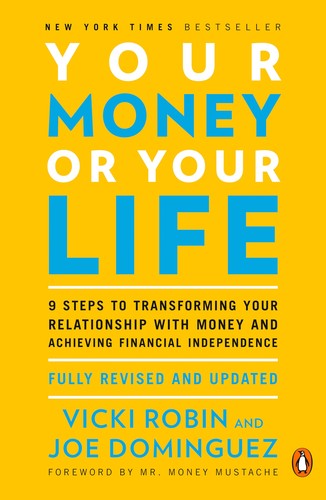
Your Money or Your Life: 9 Steps to Transforming Your Relationship with Money and Achieving Financial Independence

Curated by Brian Kim, CPA — every pick gets a plain-English summary and the key takeaways.
Brian Kim, CPA · 2.89M YouTube Subscribers →What this book actually teaches
- 01Money is life energy — every dollar represents hours of life you traded away, and that reframing changes purchasing decisions more than any budget does.
- 02Your real hourly wage is what's left after subtracting commute, work clothes, decompression, and other work-related time and cost — usually half the nominal number.
- 03The 'crossover point' is when investment income exceeds monthly expenses; that is the operational definition of financial independence.
- 04Track every dollar in and out — the book's habit, not its philosophy, is what produces the change.
- 05The original Treasury-bond strategy is outdated; modern readers should pair the philosophy with current index-fund or bond-ladder mechanics.
What's in this book
Vicki Robin and Joe Dominguez argue that money is something you trade your life energy for, and that the right financial question is not 'how do I earn more?' but 'how much life am I giving up for each dollar — and is the trade worth it?' This single reframing, more than any tactic in the book, is what made it the foundational text of the FIRE (Financial Independence, Retire Early) movement.
The book lays out a nine-step program. You calculate how much money you have earned in your lifetime and compare it to your current net worth, which is usually a humbling moment. You compute your real hourly wage by subtracting work-related costs and time (commute, work clothes, decompression) from your nominal wage — the real number is often half what people think they earn. You track every dollar in and every dollar out, then convert spending categories into 'hours of life energy' instead of dollars, which forces a different evaluation of what you actually want to own. You minimize spending, maximize income, and invest the difference in low-cost, low-risk income-producing assets — the original edition recommended Treasury bonds, later editions update this to broader index funds. The endpoint is the 'crossover point,' where investment income exceeds expenses and paid work becomes optional.
This is for people who feel a mismatch between how they spend their working hours and what they get out of it, for early-career professionals deciding whether to chase a higher-paying ladder, and for anyone drawn to the FIRE movement who wants the philosophy that started it.
The weaknesses are mostly mechanical, not philosophical. The original investment chapter — long-dated Treasury bonds as the safe income vehicle — was a product of the high-rate 1990s and does not work in a low-rate environment; the updated editions address this but unevenly. The nine-step program is genuinely demanding; the lifetime-earnings calculation and category-by-category life-energy conversion take weeks of work most readers will not actually do. The book leans contemplative, which some readers experience as preachy. And the FIRE framing has spawned a culture that sometimes pushes extreme frugality past the point of diminishing returns — that is not the book's fault, but it is the book's downstream effect.
Worth reading if the philosophy of money matters to you and you want the original FIRE-movement source text, not a derivative blog post. Skip it if you want a tactical budgeting manual.
Read next

For anyone whose financial education was "get a good job and save" — the book is most valuable for first-time readers…
Buy on Amazon →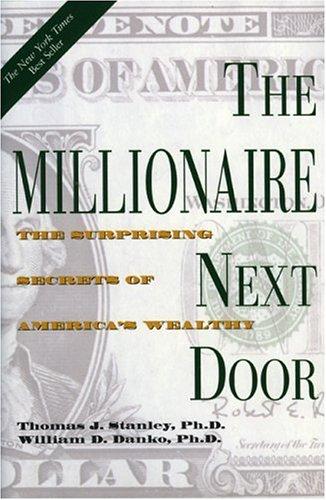
For anyone who confuses high income with wealth, or who feels behind because their lifestyle doesn't look like the we…
Buy on Amazon →
Anyone who earns enough to make discretionary spending choices but suspects their spending is not generating proporti…
Buy on Amazon →
Households in active consumer-debt distress who need a non-negotiable shared script. Not for investors already past B…
Buy on Amazon →About Vicki Robin
Read more from Vicki Robin and explore the full bibliography on ClearValue Books.
View Vicki Robin's page →Get an email if our take on Your Money or Your Life: 9 Steps to Transforming Your Relationship with Money and Achieving Financial Independence changes.
We re-review our picks. We'll email you if Your Money or Your Life: 9 Steps to Transforming Your Relationship with Money and Achieving Financial Independence's ranking or review changes — no checking back.
Across the site
Featured in lists
Recommended in answers
On Brian's lists

Ready to read Your Money or Your Life: 9 Steps to Transforming Your Relationship with Money and Achieving Financial Independence?
Buy the edition we recommend on Amazon.
Buy on Amazon →