
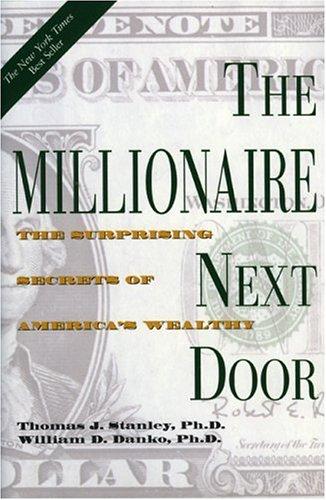
The Millionaire Next Door
The Surprising Secrets of America's Wealthy

Curated by Brian Kim, CPA — every pick gets a plain-English summary and the key takeaways.
Brian Kim, CPA · 2.89M YouTube Subscribers →What this book actually teaches
- 01Most American millionaires don't look like millionaires — they live in middle-class neighborhoods, drive used cars, and rarely buy luxury anything.
- 02Income is NOT wealth — high-income professionals are disproportionately bad at accumulating wealth because they spend it all on status signaling.
- 03The PAW formula: expected net worth = age × pre-tax income ÷ 10. Hit twice that and you're an outlier; hit half and you're under-accumulating.
- 0480% of millionaires are first-generation, self-employed in unglamorous industries (welding, dry cleaning, agricultural equipment), not heirs.
- 05Subsidizing adult children's lifestyles makes them less successful, not more — Economic Outpatient Care is one of the most damaging things wealthy parents do.
What's in this book
Thomas Stanley and William Danko spent two decades surveying American millionaires — not the visible rich on TV but the actual high-net-worth households living quietly in middle-class neighborhoods. The book's central thesis: the typical American millionaire doesn't look like a millionaire, doesn't act like one, and most importantly didn't get there by earning a giant income. They got there by living below their means, year after year, for decades.
The authors define a Prodigious Accumulator of Wealth (PAW) versus an Under Accumulator of Wealth (UAW) using a simple formula: take your age × your pre-tax income ÷ 10. That's your expected net worth. Hit twice that and you're a PAW. Hit half or less and you're a UAW. The surprising finding: high-income professionals (doctors, lawyers, executives) are disproportionately UAWs — they earn enormously, spend most of it on status signaling, and have surprisingly little wealth. Meanwhile, business owners in unglamorous industries (welding supplies, dry cleaners, agricultural equipment) routinely show up as PAWs.
Key arguments
80% of American millionaires are first-generation rich, not inheritors; they're self-employed business owners far more often than employees; they live well below their means — modest homes, used cars, no consumer-status spending; they allocate time, energy, and money efficiently in service of building wealth; they avoid lifestyle inflation even as income grows; they teach their kids to be economically independent (which means NOT subsidizing adult children's lifestyles); they choose careers and investments based on long-term cash-flow potential, not prestige.
The book's most original contribution is the "Economic Outpatient Care" framework — adult children who continue receiving financial support from wealthy parents become less productive, less successful, and less wealthy themselves. The lesson: financial subsidies to adult kids hurt them.
Weaknesses
1990s data. The economy has shifted — costs of housing, education, and healthcare have outpaced wage growth, making the "live below your means" prescription harder to execute today. The book doesn't address inequality, structural barriers, or the role luck plays in business ownership. Some critics note the survey methodology excluded coastal urban professionals whose wealth-building looks different. The follow-up books (The Millionaire Mind, Stop Acting Rich) extend the research but add diminishing returns.
The verdict
still the definitive book on what wealth actually looks like in America vs what we THINK it looks like. Read it for the mindset reset on consumption + status. The specific tactics need updating, but the underlying principle (frugality compounds harder than income) is as true today as in 1996.
Read next

For anyone whose financial education was "get a good job and save" — the book is most valuable for first-time readers…
Buy on Amazon →
Anyone who earns enough to make discretionary spending choices but suspects their spending is not generating proporti…
Buy on Amazon →
Households in active consumer-debt distress who need a non-negotiable shared script. Not for investors already past B…
Buy on Amazon →
Early-to-mid-career professionals questioning the trade between hours worked and life lived, and anyone drawn to the…
Buy on Amazon →How The Millionaire Next Door stacks up
About Thomas Stanley
Read more from Thomas Stanley and explore the full bibliography on ClearValue Books.
View Thomas Stanley's page →Available formats
Get an email if our take on The Millionaire Next Door changes.
We re-review our picks. We'll email you if The Millionaire Next Door's ranking or review changes — no checking back.
Across the site
Featured in lists
Recommended in answers
On Brian's lists
Famous quotes
- "Most people who live in expensive homes and drive luxury cars do not actually ha…"
- "Operate your household like a successful business — plan, budget, and work towar…"
- "Self-employed people are four times more likely to be millionaires than those wh…"
- "Wealth is not the same as income. If you make a good income each year and spend …"
- "Whatever your income, always live below your means."

Ready to read The Millionaire Next Door?
Buy the edition we recommend on Amazon.
Buy on Amazon →