
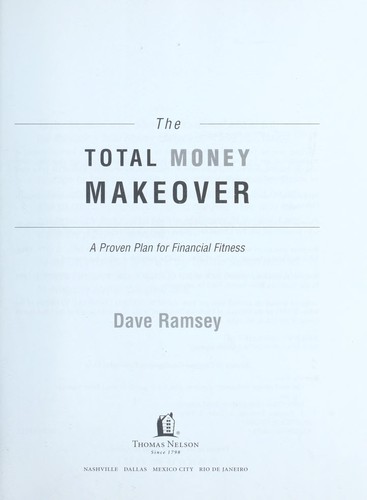
The Total Money Makeover

Curated by Brian Kim, CPA — every pick gets a plain-English summary and the key takeaways.
Brian Kim, CPA · 2.89M YouTube Subscribers →What this book actually teaches
- 01The seven Baby Steps are a sequence, not a menu — Ramsey's whole argument is that order matters more than optimization.
- 02The debt snowball pays smallest balance first for psychological momentum, even when the avalanche method saves more interest.
- 03A $1,000 starter emergency fund comes before any debt payoff so a flat tire doesn't reset the plan.
- 04Fifteen percent of gross household income into retirement is the target once non-mortgage debt is gone.
- 05Ramsey's twelve percent return assumption overstates what a real retiree should plan around — adjust the math before you act on it.
What's in this book
Dave Ramsey's core argument is that personal finance is twenty percent head knowledge and eighty percent behavior, and that the way out of money trouble is a strict, sequential, behavior-first plan rather than clever optimization. The book is the consumer-facing playbook for the Baby Steps, the seven-stage sequence Ramsey built his radio empire around, and it is unapologetically a behavior-modification book sold as a personal-finance book.
The spine of the book is those Baby Steps in order: save a $1,000 starter emergency fund; pay off all non-mortgage debt smallest balance to largest using the debt snowball; build a fully funded three-to-six-month emergency fund; invest fifteen percent of household income into retirement; save for kids' college; pay off the house early; build wealth and give generously. Ramsey argues the snowball works because of psychology, not math — small wins create momentum that an interest-rate-optimized avalanche doesn't. He hammers the idea that credit cards, car loans, and HELOCs are not tools but traps, and that you should cut them up rather than try to play the rewards game. The book is explicit that you should not use credit cards at all, ever, even paid off monthly. Surrounding the steps are short testimonial chapters from people who worked the plan — the gazelle metaphor, the beans-and-rice phase, the debt-free scream on the radio — which is what makes the book read like a revival meeting in print and what makes the program stick when math-based approaches don't.
This is for people in active debt distress, people who have tried and failed at moderate budgeting, and households where two earners need a shared, non-negotiable script. It is not for people who already max retirement accounts and are optimizing asset allocation, and it is not for sophisticated borrowers running arbitrage on low-rate fixed debt.
The weaknesses are real and worth naming. Ramsey routinely cites a twelve percent average stock-market return to justify withdrawal and savings assumptions, which is closer to a long-run nominal S&P average without inflation, fees, or sequence-of-returns risk — most planners use six to seven percent real. His blanket hostility to all debt ignores cases where low-rate fixed mortgages or zero-percent business debt are mathematically rational. The Christian framing is woven throughout and will land or grate depending on the reader. And the snowball-versus-avalanche debate is more nuanced than he allows — for high earners with discipline, the math-optimal avalanche wins meaningful dollars over a multi-year payoff.
Worth reading if you are in debt and need a behavioral system you can actually follow. Skip it if you want investing theory or a nuanced view of when leverage is appropriate.
Read next

For anyone whose financial education was "get a good job and save" — the book is most valuable for first-time readers…
Buy on Amazon →
For anyone who confuses high income with wealth, or who feels behind because their lifestyle doesn't look like the we…
Buy on Amazon →
Anyone who earns enough to make discretionary spending choices but suspects their spending is not generating proporti…
Buy on Amazon →
Early-to-mid-career professionals questioning the trade between hours worked and life lived, and anyone drawn to the…
Buy on Amazon →About Dave Ramsey
Read more from Dave Ramsey and explore the full bibliography on ClearValue Books.
View Dave Ramsey's page →Get an email if our take on The Total Money Makeover changes.
We re-review our picks. We'll email you if The Total Money Makeover's ranking or review changes — no checking back.
Across the site
Featured in lists
Compared with
Recommended in answers
Famous quotes
- "Act your wage."
- "Debt is not a tool; it is a method to make banks wealthy, not you."
- "If you will live like no one else, later you can live like no one else."
- "We buy things we don't need with money we don't have to impress people we don't …"
- "You must walk to the beat of a different drummer. The same beat that the wealthy…"

Ready to read The Total Money Makeover?
Buy the edition we recommend on Amazon.
Buy on Amazon →