
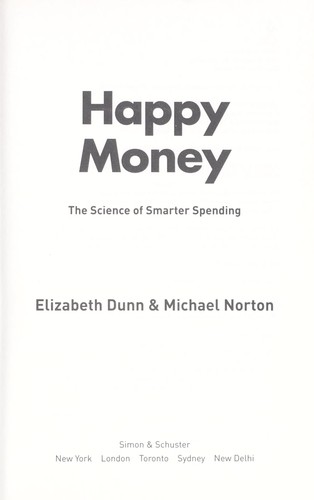
Happy Money

Curated by Brian Kim, CPA — every pick gets a plain-English summary and the key takeaways.
Brian Kim, CPA · 2.89M YouTube Subscribers →What this book actually teaches
- 01Buying experiences generates more sustained happiness than buying material goods because experiences are less subject to hedonic adaptation — we stop noticing things, but we continue deriving satisfaction from experiences through memory and anticipation.
- 02Paying to delegate disliked tasks (cleaning, commuting) produces measurable well-being gains — using money to buy time is consistently undervalued relative to using it to buy things.
- 03Spending on other people or charitable giving produces higher happiness returns than equivalent spending on oneself, a finding that holds across income levels and cultures.
- 04Paying in advance and consuming later generates anticipation and decouples the psychological pain of payment from consumption — the sequence of payment and pleasure matters.
- 05The book describes what research shows more clearly than it prescribes how to act on it — readers should expect diagnostic clarity and treat the implementation as their own work.
What's in this book
Happy Money: The Science of Happier Spending by Elizabeth Dunn and Michael Norton, published in 2013, makes an argument that is both simple and counterintuitive: most people spend money in ways that make them less happy than they could be. The book is not about spending less — it is about spending differently. Drawing on more than a decade of behavioral economics and psychology research, Dunn and Norton identify five principles that reliably increase the emotional return on spending, and show that most people's default spending patterns violate most of them.
The five principles are the book's core structure. Buy Experiences: experiences generate more sustained happiness than material purchases because they are less subject to adaptation (we stop noticing a new car or TV quickly; we continue deriving satisfaction from experiences through memory and anticipation). Make It a Treat: restricting access to pleasures — even pleasures we can afford — increases the satisfaction they provide when we do indulge. Buy Time: paying to delegate disliked tasks (cleaning, commuting, administrative work) produces measurable increases in well-being; the research shows that using money to buy time is consistently undervalued relative to buying things. Pay Now, Consume Later: the sequence of payment and consumption matters psychologically; paying in advance and then consuming later generates anticipation and decouples the pain of payment from the pleasure of consumption. Invest in Others: spending on other people or charitable giving produces higher happiness returns than equivalent spending on oneself — a finding that holds across income levels and cultures.
The research Dunn and Norton cite is drawn from their own studies and a wide body of empirical work in behavioral science. They are not making philosophical arguments; they are reporting experimental findings, and they are careful to distinguish between what the data shows and what the data cannot settle. The experimental evidence for some principles (experiences over things, investing in others) is robust and replicable. Other findings are more context-dependent — the benefits of paying in advance, for instance, are stronger for certain consumption categories than others.
The book's contribution is in translation. The underlying research had been published in academic journals, but Dunn and Norton make it accessible to a general audience without sacrificing precision. The writing is clear, the examples are concrete, and the authors are honest about the limits of the evidence. They do not oversell the findings or suggest that following these principles guarantees happiness — they argue that applied to spending decisions, the research offers a better guide than intuition alone.
This is for anyone who earns enough to make discretionary spending choices but suspects their spending is not generating the satisfaction it should — particularly useful for readers who have increased their income without a corresponding increase in day-to-day contentment.
The weaknesses are scope and application. The book describes what the research shows; it is less useful as a practical system for changing behavior. Readers looking for a budget framework or a step-by-step spending audit will find the principles clear but the implementation underspecified — there is no worksheet for categorizing current spending against the five principles or prioritizing where to reallocate. The 2013 publication date also means some of the cited research predates replications and meta-analyses that have refined (and in some cases complicated) the original findings. The happiness literature has also moved since publication, particularly on the experience-versus-material distinction, where subsequent research has introduced more nuance.
For the question of whether changing how you spend could produce more satisfaction than spending more, Happy Money is one of the most empirically grounded treatments available in the personal finance genre.
Read next

For anyone whose financial education was "get a good job and save" — the book is most valuable for first-time readers…
Buy on Amazon →
For anyone who confuses high income with wealth, or who feels behind because their lifestyle doesn't look like the we…
Buy on Amazon →
Households in active consumer-debt distress who need a non-negotiable shared script. Not for investors already past B…
Buy on Amazon →
Early-to-mid-career professionals questioning the trade between hours worked and life lived, and anyone drawn to the…
Buy on Amazon →About Elizabeth Dunn
Read more from Elizabeth Dunn and explore the full bibliography on ClearValue Books.
View Elizabeth Dunn's page →Get an email if our take on Happy Money changes.
We re-review our picks. We'll email you if Happy Money's ranking or review changes — no checking back.
Across the site
Featured in lists
- The Best Financial Psychology Books (#1 pick)
Compared with
Recommended in answers
Famous quotes
- "Abundance is the enemy of appreciation. Introducing scarcity into our consumptio…"
- "Buying time — outsourcing disliked tasks — makes people happier regardless of in…"
- "Giving to others makes us happier than spending money on ourselves."
- "Money spent on experiences brings more happiness than money spent on material go…"
- "Pay now, consume later — the opposite of credit cards — produces more happiness …"
