
The Best Financial Psychology Books.
Your relationship with money shapes every financial decision you make
Most financial advice treats money as a math problem. Earn more than you spend, invest the difference, compound over time — and the numbers will take care of themselves. What that advice misses is the psychological infrastructure underneath every financial decision: the childhood messages about money that became unconscious beliefs, the emotional states that drive impulsive spending, the identity attachments that make frugality feel like deprivation, and the fear of success that sabotages wealth accumulation even when the knowledge and opportunity are present. The books on this list address that psychological layer directly. They aren't budgeting guides or investment manuals — they're investigations into why we do what we do with money, and how to interrupt the patterns that work against us. If you've read the tactical personal finance books and still can't execute, this is your reading list.
Selected for psychological depth, clinical or research credibility, and practical relevance to the kinds of financial decisions real people face. Books that use money as a metaphor for general self-help were excluded in favor of titles that engage directly with financial behavior and its psychological roots.
The list, in order
- №1◈ Spending & Happiness
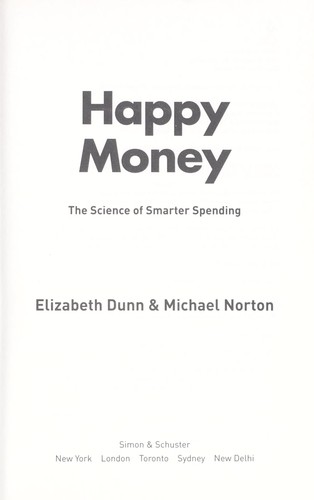
Happy Money
by Elizabeth Dunn
◈CanonElizabeth Dunn and Michael Norton's research-based analysis of what spending actually produces happiness upends most people's intuitive assumptions. Their finding that buying experiences rather than things, and spending on others rather than yourself, consistently produces higher reported wellbeing has direct implications for how you structure your spending — not just to feel better, but to get more actual happiness per dollar. The book turns money psychology into a practical optimization problem.
- №2◈ Money & Mythology
The secret life of money
by Tad Crawford
Tad Crawford explores the mythological and symbolic dimensions of money — the stories, rituals, and beliefs about money that operate far below the level of conscious financial decision-making. This is not a conventional personal finance book; it's an anthropological investigation of why money carries such emotional weight in human psychology and culture. Readers who feel irrationally blocked around wealth accumulation often find the answer here.
- №3◈ Therapeutic Framework
Emotional currency
by Kate Levinson
Kate Levinson's therapeutic approach to understanding your financial life is grounded in years of clinical practice with clients whose financial problems turned out to be psychological problems in disguise. The exercises she provides for identifying your money story, your financial fears, and the emotional payoff of your spending patterns are the most practically useful tools in this genre for actually changing behavior rather than just understanding it.
- №4◈ Core Beliefs
The money code
by Joe Duran
Joe John Duran builds a framework for understanding the core money beliefs that drive financial behavior — what he calls your 'money code' — and shows how those beliefs, formed largely in childhood and early adulthood, continue to determine financial decisions decades later. The assessment tools in this book are unusually precise for a popular finance title, making it possible to identify your specific money archetype and the behaviors it tends to produce.
- №5◈ Financial Myth-Busting
The lies about money
by Ric Edelman · 2007
Ric Edelman's rigorous demolition of the most persistent myths about money — from the idea that you should pay off your mortgage early to the belief that individual stock picking beats diversification — reads as financial psychology because the myths themselves are psychological products. Understanding why false beliefs about money are so persistent and emotionally resonant is as important as knowing the correct financial answer, because the correct answer won't stick until the false belief is dislodged.


Get notified when our book picks change.
Set it once. We'll email you when a pick worth knowing about changes — no checking back.
Questions about this list
How do childhood experiences with money affect adult financial behavior?
Profoundly and often invisibly. Money beliefs formed in childhood — that money is scarce, that wealthy people are greedy, that talking about money is impolite — operate as unconscious rules that shape financial decisions throughout adulthood. 'Emotional Currency' and 'The Money Code' both provide frameworks for identifying these inherited beliefs and evaluating whether they're still serving you or working against you.
Why do people who earn good salaries still live paycheck to paycheck?
Lifestyle inflation and the absence of a saving identity. As income grows, spending typically grows proportionally, often driven by social comparison and the belief that a certain income level entitles a certain lifestyle. 'Happy Money' research shows that the spending choices high earners make with their incremental income — typically on bigger houses, luxury goods, and status signals — generate less wellbeing per dollar than they expect. The psychology of spending precedes the mechanics of saving.
Can therapy actually help with money problems?
When the money problem is rooted in behavior rather than knowledge, yes. Financial therapists — a formally recognized specialty — work specifically on the intersection of financial planning and psychological behavior change. 'Emotional Currency' was written by a therapist who specializes in this area and provides the clearest map of when financial therapy addresses what financial planning cannot.