
The Best Personal Finance Books for Saving.
From extreme frugality to values-based spending — the books that actually change your savings rate
Saving money is not complicated. Spend less than you earn and put the difference somewhere it grows. The part that's hard is everything that makes that simple statement feel impossible: the gap between what you earn and what life actually costs, the social pressure to keep up with others, the psychological pull of immediate pleasure over future security, and the exhausting grind of making small sacrifices that individually feel meaningless. The books on this list address that gap in fundamentally different ways. Some are radically practical, cataloging specific tactics for cutting costs in every spending category. Others reframe the question entirely — not 'how do I spend less?' but 'what does money really buy, and is this purchase worth the hours of my life I traded for it?' The best saving books combine both: a clear values framework that makes frugality feel purposeful rather than punitive, and specific tactical guidance for actually reducing the costs of housing, food, transportation, and everything else. These five books represent the full spectrum of that approach.
We selected books with a demonstrated track record of changing readers' savings behavior, not just their savings knowledge. Each title provides either a specific tactical system for reducing expenses or a philosophical framework compelling enough to motivate sustained behavior change. We excluded books that talk about the importance of saving without giving readers concrete tools to actually do it.
The list, in order
- №1◈ Best comprehensive frugality reference
The complete Tightwad gazette
by Amy Dacyczyn · 1998
Amy Dacyczyn's collected newsletters from the 1990s remain the most comprehensive practical guide to frugal living ever assembled. Spanning over 900 pages, The Complete Tightwad Gazette covers grocery savings, DIY home maintenance, bulk buying, second-hand shopping, and hundreds of other specific tactics with the rigor of someone who lived this way out of necessity and turned it into a philosophy. Skeptics who 'already know how to be frugal' consistently find ideas they hadn't considered.
- №2◈ Best for lifestyle-design frugality
Living well, spending less
by Ruth Soukup
Ruth Soukup's 2014 memoir-meets-manual is the most accessible entry point for readers who find extreme frugality alienating. Her story — going from $40,000 in credit card debt while making a six-figure income to a genuinely abundant life on a fraction of her former spending — illustrates that frugality isn't about deprivation but about clarity on what actually makes you happy. The book's practical exercises are among the best in the genre.
- №3◈ Best for value-based spending decisions
Frugal isn't cheap
by Clare K Levison
Clare Levison's book makes a distinction that changes how readers approach saving: being frugal is getting value from every dollar, while being cheap is just paying less regardless of value. This reframe liberates readers from the false choice between spending freely and penny-pinching miserably. Her framework helps readers identify where in their life spending is producing genuine value and where it's just automatic — and cut only the latter.
- №4◈ Best for understanding spending psychology
The $1,000 Challenge
by Brian J O Connor
Journalist Kath Kelly's experiment in cutting her monthly budget to £1,000 in London is the most entertaining book on this list and, paradoxically, one of the most practically useful. By documenting every spending decision in real time, Kelly creates a granular record of where money actually goes and which expenses she genuinely missed versus which she didn't notice being gone. Ideal for readers who want to understand their own spending psychology through someone else's vivid example.
- №5◈ Best philosophical framework for saving
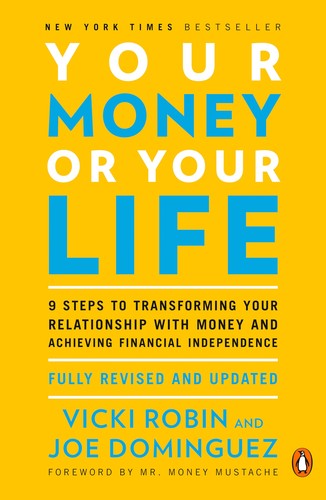
Your Money or Your Life: 9 Steps to Transforming Your Relationship with Money and Achieving Financial Independence
by Vicki Robin · 1992
◈CanonThe philosophical foundation of the savings movement. Vicki Robin's question — how many hours of your life did you trade for this purchase? — reframes every spending decision in terms of the finite resource that actually matters: time. Her concept of calculating your 'real hourly wage' (subtracting work-related expenses and decompression time) makes most people's effective hourly rate significantly lower than their nominal salary, which changes the math on dozens of routine purchases.


Get notified when our book picks change.
Set it once. We'll email you when a pick worth knowing about changes — no checking back.
Questions about this list
How much should I be saving each month?
The standard advice is 20% of take-home income, but the right number depends on your goals and timeline. Saving for a house down payment in 3 years requires a different rate than building a retirement fund over 30 years. Your Money or Your Life offers the most useful framework for calculating your target savings rate based on what you actually want your life to look like — it's more personalized than any percentage rule.
Is The Complete Tightwad Gazette too extreme for modern life?
Some tactics are dated (the book was written in the early 1990s) and some assume a lifestyle most modern readers don't have. But the principles — batch cooking, bulk buying, DIY repairs, trading time for money thoughtfully — are as applicable today as when Dacyczyn wrote them. Skip the chapters that don't apply to your situation and work through the rest; most readers find 20-30 actionable ideas per hundred pages.
Can frugality books help if I'm already on a tight budget?
The most useful books for readers with very tight budgets are The Complete Tightwad Gazette (specific tactical savings across every spending category) and The 1,000 Challenge (psychological reframing of necessity-based frugality). Your Money or Your Life becomes more useful once you have some discretionary income to redirect, since its framework is most powerful when applied to spending choices rather than unavoidable necessities.