
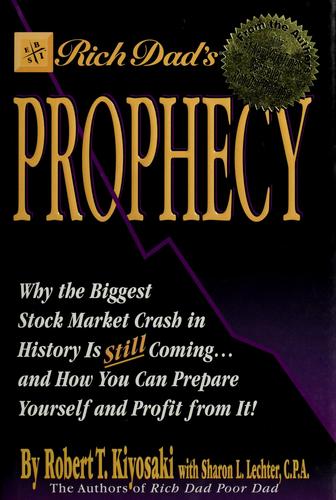
Rich dad's prophecy

Curated by Brian Kim, CPA — every pick gets a plain-English summary and the key takeaways.
Brian Kim, CPA · 2.89M YouTube Subscribers →What this book actually teaches
- 01ERISA shifted retirement risk from employers to financially uneducated individuals — that is the structural critique.
- 02Kiyosaki predicted a forced-selling crisis as boomers hit RMDs around 2016; that specific prediction did not play out.
- 03The prescription is cash-flowing assets, real estate, and hard assets outside tax-deferred accounts.
- 04The book recycles substantial material from the original Rich Dad Poor Dad with diminishing returns.
- 05Several recommendations align suspiciously well with Kiyosaki's own seminar and product businesses.
What's in this book
Robert Kiyosaki's argument in Rich Dad's Prophecy is that the U.S. retirement system, built on tax-deferred 401(k)s and defined-contribution plans, is heading toward a generational crisis when baby boomers begin mandatory withdrawals and force-sell their equities into a market that won't have enough buyers. He frames this as a prediction from Rich Dad and pegs the inflection roughly to 2016, the year the first boomers turned seventy-and-a-half and triggered required minimum distributions.
The arguments stack in three parts. First, the structural critique: ERISA-era reforms shifted retirement risk from employers (defined-benefit pensions) onto individuals (defined-contribution accounts), and most individuals are financially uneducated, so the system is a slow-motion failure. Second, the demographic mechanism: a wave of forced selling from boomers withdrawing from 401(k)s will collide with a smaller, less wealthy buying cohort, pressuring asset prices. Third, the prescription: build financial education, acquire cash-flowing assets outside the wrapped retirement accounts, learn to use debt as a tool, and prepare for volatility through hard assets, real estate, and businesses rather than passive index exposure inside an IRA.
This is aimed at readers who already accept the Rich Dad framework and want a macro lens on why following the standard retirement script is risky.
The weaknesses are substantial. The headline prediction did not play out as described — 2016 came and went without the forced-selling collapse, and the demographics-as-destiny case has been challenged by economists who point out that RMDs are spread out, retirees don't fully liquidate, and global capital flows in. Kiyosaki's solution set leans heavily on real estate and gold-and-silver positioning that conveniently matches his other businesses and seminars, which is a recurring conflict-of-interest pattern across the Rich Dad series. The book also recycles a lot of material from Rich Dad Poor Dad and the CASHFLOW Quadrant without much new analytical depth, and the Rich Dad character himself has been credibly questioned as a literary device rather than a real mentor.
Worth skimming as a critique of the standard retirement playbook. Not worth treating as a forecast — the central prophecy didn't land, and the financial-education argument is made better in the original Rich Dad Poor Dad.
Read next

For high earners who feel financially successful but unsatisfied, and for anyone grinding toward a financial independ…
Buy on Amazon →
People within five to ten years of retirement who have addressed the financial planning and are beginning to think se…
Buy on Amazon →
For adults 45 and older who feel behind on retirement savings and want a realistic framework for what to do — not a p…
Buy on Amazon →
Professionals in their 30s through 50s doing long-range financial planning, particularly those in careers facing tech…
Buy on Amazon →About Robert T Kiyosaki
Read more from Robert T Kiyosaki and explore the full bibliography on ClearValue Books.
View Robert T Kiyosaki's page →Get an email if our take on Rich dad's prophecy changes.
We re-review our picks. We'll email you if Rich dad's prophecy's ranking or review changes — no checking back.
Across the site
Recommended in answers

Ready to read Rich dad's prophecy?
Buy the edition we recommend on Amazon.
Buy on Amazon →