

The Truth About Your Future

Curated by Brian Kim, CPA — every pick gets a plain-English summary and the key takeaways.
Brian Kim, CPA · 2.89M YouTube Subscribers →What this book actually teaches
- 01A 40-year-old doing financial planning today should model living to 90-100 as a realistic scenario, not an outlier — the planning horizon for a 35-year retirement requires a substantially larger asset base than a 20-year retirement.
- 02Exponential technological change has made linear financial planning obsolete: AI and automation will disrupt a large percentage of current careers within 20 years, making career-pivot planning as important as investment planning.
- 03The conventional wisdom to shift toward bonds at retirement age is based on a 20-year retirement horizon; a 35-year horizon argues for maintaining meaningful equity exposure significantly longer.
- 04Sequence-of-returns risk — a market downturn early in retirement that depletes the portfolio before recovery — is more acute over longer retirements, requiring more conservative early-withdrawal strategies.
- 05The concept of retirement as a discrete work-then-not-work transition is being replaced by a more fluid pattern of career pivots, partial retirements, and encore careers that financial planning should model explicitly.
What's in this book
The Truth About Your Future: The Money Guide You Need Now, Later, and Much Later by Ric Edelman, published in 2017, argues that the financial planning industry is operating with outdated assumptions — about how long clients will live, what careers will look like, how quickly technology will disrupt current income streams, and what retirement actually means — and that most individuals are making long-range financial decisions based on projections that will prove dramatically wrong.
Edelman's core argument is that exponential technological change has made linear financial planning obsolete. The standard financial plan assumes a predictable income trajectory, a career in a stable field, a retirement at 65, a life expectancy in the mid-to-late 70s, and investment returns calibrated to a historical record that may not reflect the coming decades. Edelman argues that all five assumptions are questionable. Artificial intelligence and robotics will eliminate or transform a large percentage of current jobs within 20 years. Life expectancy is increasing faster than financial planning models account for. The concept of retirement as a discrete phase of life — work, then not-work — is being replaced by a more fluid pattern of career pivots, partial retirements, encore careers, and late-in-life entrepreneurship.
The longevity chapters are the most substantive part of the book. Edelman draws on actuarial data and biomedical research to make the case that a 40-year-old planning today should model scenarios where they live to 90, 95, or 100 — not as an outlier case but as a realistic planning assumption. The financial implications are significant: a 35-year retirement requires a substantially larger asset base than a 20-year retirement, and the sequence-of-returns risk (the danger that a market downturn in early retirement depletes the portfolio before recovery) is more acute over a longer horizon.
The career disruption chapters are framed as planning problems, not just economic observations. Edelman advises readers to assume their current career will be meaningfully disrupted within ten years and to model what income replacement would look like — a career pivot, a skill upgrade, reduced hours, or a full transition. He provides frameworks for evaluating which careers face the most acute automation risk and which represent more durable income sources, though these assessments are necessarily speculative.
The investment chapters apply the longevity thesis to portfolio construction. If a 65-year-old retiree should plan to live another 30-35 years, an equity-heavy portfolio held through early retirement looks different than the conventional advice to shift toward bonds at retirement age. Edelman argues for maintaining meaningful equity exposure longer than conventional retirement planning suggests, calibrated to the extended planning horizon rather than age as a proxy.
Who this is for: professionals in their 30s through 50s doing long-range financial planning, and anyone whose career is in a field that faces significant technology disruption in the next 10-20 years. Particularly useful for readers whose financial plan was built on a standard 20-year retirement assumption that may significantly understate the actual planning horizon.
Weaknesses
the technology disruption forecasts are speculative, and Edelman's confidence in specific timelines for AI and robotics adoption has aged inconsistently — some predictions have arrived early, others have not materialized on schedule. The 2017 publication date predates the COVID-19 pandemic's acceleration of remote work and gig economy shifts, which would have been relevant case material. The book is better at identifying the questions that conventional financial planning fails to ask than at providing specific tactical answers to those questions.
Verdict
a useful corrective to the assumption-set embedded in most conventional retirement planning — the longevity and career-disruption framing alone justify reading it even if some of the technology predictions are directionally right but temporally uncertain.
Read next

For high earners who feel financially successful but unsatisfied, and for anyone grinding toward a financial independ…
Buy on Amazon →
People within five to ten years of retirement who have addressed the financial planning and are beginning to think se…
Buy on Amazon →
For adults 45 and older who feel behind on retirement savings and want a realistic framework for what to do — not a p…
Buy on Amazon →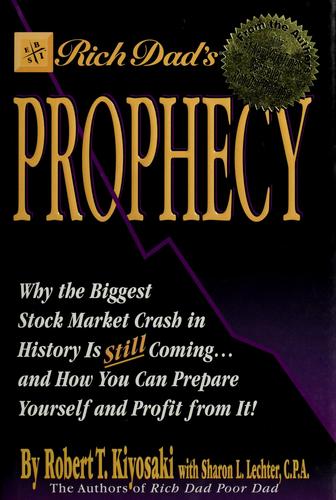
Existing Rich Dad readers curious about the macro and retirement-policy critique. Not for new readers — start with th…
Buy on Amazon →How The Truth About Your Future stacks up
About Ric Edelman
Read more from Ric Edelman and explore the full bibliography on ClearValue Books.
View Ric Edelman's page →Get an email if our take on The Truth About Your Future changes.
We re-review our picks. We'll email you if The Truth About Your Future's ranking or review changes — no checking back.
Across the site
Featured in lists
- Best Retirement Books for Late Starters (2026) (#1 pick)
- The Best Investing Books of the 2020s (#3 pick)
- The Best Retirement Planning Books (2026) (#3 pick)
- The Best Finance Books of 2026 (#4 pick)
- The Best Retirement Books for 401(k) Planning (#5 pick)
Compared with
Recommended in answers
Famous quotes
- "Exponential technologies are going to change everything about how we live, work,…"
- "Everything you've been taught about financial planning is obsolete."
- "Longevity is the biggest financial risk most people face — and the most ignored."
- "Retirement as we know it is ending. What replaces it will be better — but only i…"
- "You will have multiple careers — not multiple jobs within one career, but entire…"
Topic hubs

Ready to read The Truth About Your Future?
Buy the edition we recommend on Amazon.
Buy on Amazon →