
Reading Order for FIRE Aspirants.
The books that built the movement — read in the order that builds the philosophy before the math
Books in this guide.



Financial Independence, Retire Early — FIRE — is one of the few personal finance movements that has a traceable intellectual history. The core ideas developed over decades, the key books reference each other, and the sequence in which they're read significantly affects how well the framework lands.
Reading the FIRE canon out of order often produces misunderstanding: readers encounter the math of safe withdrawal rates before they've internalized the philosophy behind the movement, or they find the frugality extreme before they've read the foundational argument for why spending patterns are the core variable.
This reading order is designed to sequence the philosophy before the optimization.
Start with the origin text
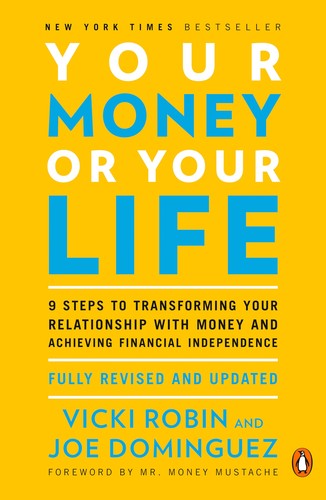
Your Money or Your Life by Vicki Robin and Joe Dominguez is the book that seeded the modern FIRE movement, even if Robin and Dominguez didn't use that term. First published in 1992, updated in 2008, it introduced the concept of treating money as a store of life energy — that every dollar spent represents a certain number of hours worked, and those hours represent a portion of a finite life.
This reframe is the load-bearing idea under all FIRE thinking. Without it, early retirement optimization looks like extreme frugality. With it, it looks like a rational response to the finite nature of time. Read this first.
Add the behavioral foundation
After Your Money or Your Life, read The Psychology of Money by Morgan Housel. The FIRE community sometimes approaches its own philosophy with a rigidity that can become another form of the optimization mindset it claims to reject. Housel's book introduces the concept of "enough" without prescribing what enough looks like for any particular reader — which is the correct framing for a philosophy that needs to be adapted to individual circumstances.
Move to the practical framework
The Simple Path to Wealth by JL Collins is the FIRE community's most-cited practical investment guide. Collins originally wrote the book as a series of letters to his daughter, and that origin gives it an unusually direct, personal voice. The argument is straightforward: accumulate index funds, spend less than you earn, reach a savings rate that generates a sufficient withdrawal rate, and stop trading time for money.
Collins addresses the 4% safe withdrawal rate research and the specific mechanics of portfolio construction in plain language. This book is the operational manual for the investment side of FIRE.
Understand wealth and framing
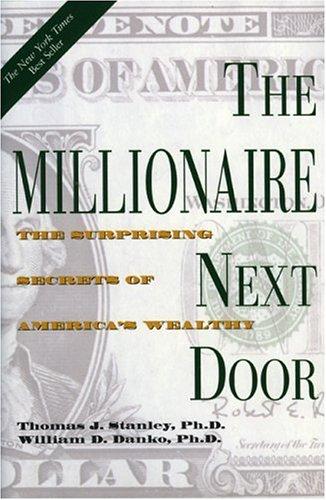
The Millionaire Next Door by Thomas Stanley and William Danko is not a FIRE book, but it provides useful empirical grounding for the FIRE thesis. The book's central finding — that most genuinely wealthy Americans built their wealth through sustained saving and avoidance of lifestyle inflation, not high income — validates the behavioral underpinning of FIRE without coming from inside the movement.
Reading it after The Simple Path to Wealth adds a sociological dimension to what Collins describes as an individual optimization problem.
Examine the identity question
How Much Is Enough? by Robert and Edward Skidelsky is the most philosophically sophisticated book on this list. It's not a personal finance book in any conventional sense — it's a work of political economy that asks what kind of life is worth living and what "enough" means as a human rather than financial question. The FIRE community often engages with the question of enough at the level of portfolio math; the Skidelskys engage with it at the level of what people actually want their lives to look like.
Read this after the practical books. It functions as a reflective counterweight to the optimization energy that most FIRE content generates.
The accelerated path
Your Money or Your Life establishes the philosophy. The Psychology of Money fixes the behavioral layer. The Simple Path to Wealth provides the mechanics. The Millionaire Next Door supplies the empirical validation. How Much Is Enough? asks whether the destination is worth the journey.
Together, these books form a complete FIRE education — one that prepares readers not just to reach financial independence, but to have thought carefully about what they plan to do once they get there. That second question is the one the FIRE community historically underinvests in, and it's the one that determines whether early retirement is actually satisfying.
Common questions.
Is FIRE realistic for people with average incomes?
FIRE outcomes depend on savings rate more than income. A person earning $60,000 with a 40% savings rate accumulates wealth faster than a person earning $150,000 with a 5% savings rate. The books in this sequence make that case with data.
Where does Mr. Money Mustache and other blog-based FIRE content fit?
Community content — blogs, forums, podcasts — is valuable for motivation and tactics, but the books above are more durable for foundational thinking. Read the books first, then use community content for ongoing refinement and community.
Is the 4% rule covered in these books?
Yes — The Simple Path to Wealth covers the 4% rule (the Bengen/Trinity study) in accessible terms, including its assumptions, limitations, and the scenarios where it fails. It's the most thorough lay treatment of the topic in this reading list.