
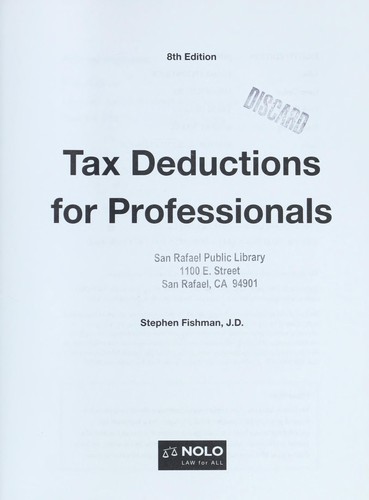
Tax deductions for professionals

Curated by Brian Kim, CPA — every pick gets a plain-English summary and the key takeaways.
Brian Kim, CPA · 2.89M YouTube Subscribers →What this book actually teaches
- 01Continuing education and professional development costs that maintain existing credentials are deductible; costs for entering a new profession or career change are not — a distinction the IRS enforces and most professionals get wrong.
- 02The Tax Cuts and Jobs Act of 2017 excluded "specified service trades or businesses" (SSTBs) — most licensed professional fields — from the qualified business income deduction at high income levels, making the QBI deduction phase-out one of the most consequential provisions for high-earning professionals.
- 03Many states restrict which entity structures licensed professionals can use — the professional corporation (PC) or PLLC structure available in a given state affects both liability protection and the S-corp election strategy for reducing self-employment tax.
- 04Solo 401(k) and SEP-IRA contributions are particularly high-value for profitable solo professionals because their income is often substantially above the contribution thresholds that limit the deduction's impact for lower earners.
- 05Professional liability insurance, malpractice coverage, and errors-and-omissions premiums are fully deductible as ordinary and necessary business expenses — a category professionals frequently undercount when estimating their deductible expenses.
What's in this book
Tax Deductions for Professionals by Stephen Fishman is a NOLO title aimed at a specific segment of self-employed workers: licensed professionals — physicians, attorneys, architects, accountants, engineers, consultants, therapists, and others who earn income from knowledge and credentialed expertise rather than from selling products. The book's organizing argument is that professionals have a different deduction profile than general small business owners, and a general small-business tax guide will both miss deductions specific to their situation and bury them in analysis that doesn't apply. Fishman, a NOLO attorney who has written extensively on self-employment tax, structures the book to serve this audience directly.
The professional-specific deductions receive the most detailed treatment. Continuing education and professional development costs — licensing renewal fees, bar association dues, medical board fees, professional journals, and courses required to maintain credentials — are deductible as ordinary and necessary business expenses and represent a category most professionals undercount. Fishman explains the IRS distinction between expenses that maintain existing credentials (deductible) and expenses for a new profession or career change (not deductible), a line that catches many professionals who attempt to deduct broadly. Professional liability insurance, malpractice insurance, and errors-and-omissions coverage are covered in detail, along with the home office deduction as it applies to professionals who see clients at home or maintain a principal administrative office there.
Business structure receives sustained attention because the choice between operating as a sole proprietor, S corporation, or professional corporation (PC) or professional limited liability company (PLLC) has significant tax and liability implications for licensed professionals. Many states restrict which entity structures licensed professionals can use, and Fishman explains the state-law overlay alongside the federal tax analysis. The S corporation reasonable compensation question — relevant for profitable professionals who want to reduce self-employment tax — is treated with the IRS scrutiny level that solo-practice professionals actually face.
The book also covers the deduction for a portion of health insurance premiums for self-employed professionals, retirement contributions through SEP-IRA and Solo 401(k) structures (particularly relevant for high-income professionals with significant tax reduction incentive), and the qualified business income (QBI) deduction introduced by the Tax Cuts and Jobs Act of 2017. The QBI deduction treatment is particularly important for professionals: the TCJA specifically excluded "specified service trades or businesses" (SSTBs) — which includes most licensed professional fields — from the deduction at high income levels, phasing it out for joint filers above approximately $383,000 in 2024 income. Fishman explains the SSTB exclusion and the phase-out threshold in editions that postdate the TCJA.
For self-employed physicians, attorneys, CPAs, consultants, therapists, and other licensed professionals operating as sole proprietors or in solo or small-group practice, this guide covers the deduction landscape with more precision than any general self-employment tax guide.
Where it falls short
the SSTB limitation on the QBI deduction — one of the most consequential tax provisions for high-income professionals — means this book's planning content is highly edition-dependent; readers should confirm their edition is post-TCJA. The book is federal-only; state professional practice rules and state income tax treatment of professional deductions are not covered. Large group practices, hospital-employed physicians, or professionals in partnership structures will find the entity-level analysis limited.
Verdict
the most targeted and practically useful tax deduction guide available for self-employed licensed professionals. Worth reading alongside professional liability and entity-structure advice from a CPA who works with professional practices.
Read next

For anyone whose financial education was "get a good job and save" — the book is most valuable for first-time readers…
Buy on Amazon →
For anyone who confuses high income with wealth, or who feels behind because their lifestyle doesn't look like the we…
Buy on Amazon →
Anyone who earns enough to make discretionary spending choices but suspects their spending is not generating proporti…
Buy on Amazon →
Households in active consumer-debt distress who need a non-negotiable shared script. Not for investors already past B…
Buy on Amazon →About Stephen Fishman
Read more from Stephen Fishman and explore the full bibliography on ClearValue Books.
View Stephen Fishman's page →Get an email if our take on Tax deductions for professionals changes.
We re-review our picks. We'll email you if Tax deductions for professionals's ranking or review changes — no checking back.

Ready to read Tax deductions for professionals?
Buy the edition we recommend on Amazon.
Buy on Amazon →